

I wrote previously about my rules on persuasion, a set of rules designed around brokering deals. In my last running, the party was asked to relieve the sadness of the inhabitant of a mysterious tower. My players were unaware of the rules, and I totally neglected to teach them to my players. As I was thinking about it, I came up with a different approach that feels cleaner, well-differentiated from combat, and also far more specific.
I already have a deck of cards as part of my running materials, as we play blackjack whenever my players gamble. That let me to think about other ways I could use the cards during play, and the application to persuasion came in one of those post-midnight flashes of insight. The following approach is indebted to the Russian card game дурак and Zak Sabbath's use of the tarot deck in Demon City.
These rules come into effect whenever the players make a reasonable request of an NPC. Reasonable here means the request is not inherently absurd, impossible, etc. Asking a city watch member to let the party pass is a reasonable request, while asking an innkeeper to believe the party are incarnated gods is not.
Representing the NPC's resistance to the suggestion, the Facilitator will draw, facedown, a number of cards from the deck equal to the NPC's Ascetic tier (1 for Novice, 2 for Apprentice, and so on). The first card drawn represents the NPC's fundamental resistance to the request. If an ace, the attempt fails. If not an ace, the card's suit determines the trump for that person. The player's Grokist skill then allows them to flip cards over, in the order the Facilitator drew them (one card revealed per Grokist tier).
The requesting player will then draw a number of cards equal to their Orator tier, reflecting the arguments available to them at the moment. The player must then choose a number of their cards to play against the NPC's resistance. If they can't match the number of NPC cards, the check immediately fails. If they can match the number of cards, the Facilitator will reveal all of the NPC's cards. In order to succeed, the player must be able to "beat" every displayed card.
In order to beat a card, the player's card must match suit and have equal or greater numerical value (aces are high) or belong to the trump suite.
Each suite corresponds to a persuasion tactic, and the trump suite reflects the strategy to which the NPC is most vulnerable.
Hearts - charm or seduce
Diamonds - bribe
Spades - rationalize
Clubs - threaten
Accordingly, the players can modify some of their cards.
Hearts and Spades values are immutable, but the player may discard a card (either played or unplayed) to change the suite of a card within color (heart to diamond) or to raise an immutable card's value as though it were the other suite (increasing a spade through the mechanic used to increase a club).
Diamond values are increased through spending money. Playing a diamond card requires an initial investment based upon the day rate of the current city, and doubling that amount increases the value of the diamond by 1.
Club values are increased by the persuading character's companions. Each companion with at least 1 rank in Combatant can be used to increase a club's value by 1, once (that is, if the player needs to increase two different clubs by 1, their character need two companions, one per card). However, the number of companions unused must always exceed the NPC's number of companions (if attempting to persuade 4 guards, the persuading character must have more than 4 companions to spend them increasing club values).
If the player beats the NPC's cards, the NPC accedes to the request. If the player fails, the consequences depend upon the undefeated cards.
Hearts leave the NPC embittered towards the PC, and the value on the card represents the feeling's intensity. A number card (2-10) indicates the number of days the NPC will remember the incident - anytime the party encounters the NPC's faction, that NPC will be present and interfere as much as possible (all tests are hard).
Jack: the NPC hires a band of imposters to tarnish the party's reputation.
Queen: the NPC hires a band of brigands to waylay the party and take their stuff.
King: the NPC targets the party's followers and hirelings, forcing them to make a morale roll. If they fail, their morale increases by 1.
Ace: the NPC allies with an enemy of the party or becomes a new antagonist.
Diamond failures require the party to pay through the nose to avoid the Hearts result. The value on the card equals the number of doublings of the daily rate required to assuage the NPC (so, a 4 of Diamonds means the players must pay 16 * the daily rate). The Jack, Queen, King, and Ace are equal in value to 11, 12, 13, and 14, respectively.
Clubs make the NPC belligerent. For number cards (2-10), if the NPC has Combatant ranks, roll 1d10. If the result is less than the number, the NPC and their group attacks until someone has taken an injury or another group of individuals intervenes. If the NPC does not have Combatant ranks, they will find someone who does. The number on the card equals the number of people they find interested in teaching the party a lesson.
Jack: the NPC trashes the party's lodgings.
Queen: the NPC motivates a new faction to take action against the party.
King:the NPC attempts to kidnap someone about whom the party cares.
Ace: the NPC commits everything they have into subduing the party.
Undefeated spades neutralize the player's cards. A number card removes a player's card of lesser numerical value (player's choice).
Jack: neutralizes two cards below Jack
Queen: neutralizes three cards below Queen
King: neutralizes four cards below Queen
Ace: neutralizes all cards and copies the penalty of the highest red card.
Final notes
If there are multiple failures of the same suit, all penalties stack if possible. For clubs, roll for each card. Each additional roll indicating combat attracts an additional fighter to the fray.
NPCs with no ranks in Ascetic cannot defend with face cards or aces - if such a card is drawn, return it to the deck and draw again. This ensures there aren't inordinate penalties to interacting someone without the actual capacity to hinder the party.
Shuffle the Jokers into the deck. If the Joker is trump, the NPC agrees to the request immediately. Any card defeats a defending Joker, and Jokers cannot be played to defeat other cards.
Until the consequence of the persuasion attempt has occurred and a new day has begun, the party may not attempt to persuade the same person(s) again.
Subscribe!

 Posts
All Comments
Thursday, August 2, 2018

Tuesday, July 31, 2018
Monster Descriptions
There are a lot of things I want to improve on as a Facilitator. Most I will improve by doing them over and over again. I've only been running games for about 5 years, so I have a lot of improving to do. One of the things on my to-improve list is describing things. I have aphantasia, which complicates my ability to describe how things appear. This gets compounded because I know the names of all the things my players encounter, and so the temptation to refer to things solely by their name is strong.
Fortunately, practice makes permanent. My bestiary stands at around 150 creatures, and I aim to write a short description of one monster a day until I run out of monsters. Since my players read this, I'll leave the names off, and it might be fun if readers left a suggestion or a guess.
Black ink drools from the top of the frog's head into the marsh. The toddler-sized frog hides in the reeds at the marsh's edge, waiting for its toxin to wend through the water.
Joining a Faction
Institutional support can be invaluable for new (and impoverished) adventurers. For example, in Alexis' Juvenis campaign, it is because we are acting as representatives of Stavanger that our current cave exploration has gone as smoothly as it has.
Players new to games that require a lot of logistical considerations (food tracking, encumbrance, etc.) often are overwhelmed with the responsibility of handling all of this on top of the more "normal" player responsibilities. In-game institutions can provide scaffolding for these players, providing support that diminishes as players become better at playing the game.
In Prodigy, I call these types of institutions "factions" since there are always several in an area, each vying for power. As part of character creation, players can choose a faction appropriate to their trade (class), joining that faction and gaining additional proficiency in a faction-specific skill.
Faction membership is only limited by geography (most factions exist only in specific areas of the world), culture (some factions only admit members from their associated culture) and trade.
To spell out the obvious, factions provide a number of built-in services for characters: they offer employment, training, lodging and food, and (perhaps most importantly) a default goal. As I've run games, I've noticed that my players are often hesitant to define their own goals, to set their own agenda. I've found that offering some vague direction, like the goals listed above, helps players develop their agency. Having multiple characters from the same faction provides an initial consensus that helps players get moving.
The above is not new or revolutionary information. Moving forward on this, I want to further develop how players can join factions after character creation as well as better outline how a faction's presence in an area manifests - how many personnel, distributed how, pursuing what goals.
Players new to games that require a lot of logistical considerations (food tracking, encumbrance, etc.) often are overwhelmed with the responsibility of handling all of this on top of the more "normal" player responsibilities. In-game institutions can provide scaffolding for these players, providing support that diminishes as players become better at playing the game.
In Prodigy, I call these types of institutions "factions" since there are always several in an area, each vying for power. As part of character creation, players can choose a faction appropriate to their trade (class), joining that faction and gaining additional proficiency in a faction-specific skill.
| Faction | Trades Offered | Skill | Goal |
| Abigail's Steadfast | Provisioner; Soldier | Thaumaturge (Azintheen) | Protect the vulnerable |
| Adept's College | Researcher | Any Mental | Study everything |
| Areinian Constabulary | Provisioner; Soldier | Orator | Keep the peace and their money |
| Avondown Associates | Soldier; Thief | Leader | Destroy the Tarluskani regime |
| Brass Orchids | Artist; Bard; Thief | Combatant (Dextrous) | Assassinate the Tarluskani leadership |
| Catacombs Machimoi | Ognemuo, Soldier | Athlete | Defend the Catacombs |
| Facetakers | Hinterlander; Soldier; Thief | Wildcrafter | Become a wild animal |
| Hunting Brigade | Hinterlander; Provisioner; Soldier | Pathfinder | Hunt the best prey |
| Jungle Explorers' Guild | Bard; Hinterlander; Provisioner; Soldier; | Orator | Bring back the best story |
| Knights of St. Valorie | Hinterlander; Provisioner; Soldier | Thaumaturge (Azintheen) | Restore the Church of the Azintheen |
| Minstrels' Guild | Artist; Bard | Artist (any) | Advance the state of Art |
| Night Consortium | Provisioner; Soldier; Thief | Grokist | Find money |
| Nithya Jongleurs | Bard; Thief | Pickpocket | Stun the crowd. Leave town |
| Nithya Sanraksaka | Hinterlander; Soldier; Thief | Combatant (Dextrous) |
Protect the Nithya
and
Saharjin
|
| Order of St. Lussier | Provisioner; Researcher | Chemist | Heal the sick and wounded |
| Pirate Sovereigns of Korg | Hinterlander; Soldier; Thief | Sailor | Sail the seas and get plunder |
| Revelers of Kwerris the Fool | Bard; Soldier; Thief | Thaumaturge (Fiaja) | Get mystically drunk, then break things |
| Sojourners | Hinterlander | Scholar | Travel the world |
| Tarluskani Military | Hinterlander; Provisioner; Soldier | Leader | Conquer the world |
| University of Reyjadin | Researcher | Thaumaturge (Fiaja) | Advance military science |
| Yanera Custodes | Thief | Grokist | Manipulate as ordered |
| Yanera Guerreros | Hinterlander; Soldier | Athlete | Protect the Ten Tribes |
Faction membership is only limited by geography (most factions exist only in specific areas of the world), culture (some factions only admit members from their associated culture) and trade.
To spell out the obvious, factions provide a number of built-in services for characters: they offer employment, training, lodging and food, and (perhaps most importantly) a default goal. As I've run games, I've noticed that my players are often hesitant to define their own goals, to set their own agenda. I've found that offering some vague direction, like the goals listed above, helps players develop their agency. Having multiple characters from the same faction provides an initial consensus that helps players get moving.
The above is not new or revolutionary information. Moving forward on this, I want to further develop how players can join factions after character creation as well as better outline how a faction's presence in an area manifests - how many personnel, distributed how, pursuing what goals.
Thursday, June 21, 2018
Combat Rules Update: Clashing and Action Points
I wrote back in November about a Eureka moment I had regarding combat rules. The post was unintelligibly cryptic, and since I've now polished the rules up (and seen them work very well in actual play), I wanted to share them.
I'm also instituting a rather large change to how I run combats based on Alexis' use of action points. It is an elegant solution to a complicated problem, and I've wanted to adapt it to my game practically since I first encountered it. Because combat is the one area in the game where characters are most directly threatened, the combat rules need to be very clear and very fair. These rules do that, allowing me to account for most of the actions my players might undertake yet remaining flexible and easy to implement.
First, let's talk about clashing. The basic idea is that during battle, combatants cluster into larger engagements. Rather than trying to model each line of attack and defense, I want a single roll to determine which "side" in the engagement triumphs in a given round.
The best fighter on each team determines the starting difficulty, and the number of fighters on their team then adds a bonus. NPCs have a static difficulty, and the player controlling the best fighter on the players' team rolls. On a success, the players deal damage based upon the rolling player's character's weapon and the difference between the result and the difficulty. Damage is distributed among the defending creatures according to the most-skilled defender. On a failure, the players take damage, and the rolling player determines how the damage is split among the different characters on their team.
Consider the following situation:

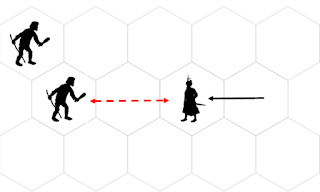
 When the second brigand engages the character, things turn a little dire. Because there is one more brigand than character, the brigands get a +3 bonus; the player still rolls 1d4+1d6+attribute but now must equal or exceed a 12. If there was an additional brigand in the clash, the player would then need to roll equal to or in excess of a 15.
 When the character's friend appears and rushes into combat, the sides are now equal. Even though the second character does not threaten the first, they are all still part of the same clash because we can connect all of the fighters together. Because both sides have an equal number of fighters, no side gets a bonus. If the second character is a Professional-rank fighter, they would roll for the clash, comparing their 2d4+1d6+attribute against the brigands' 9. If the second character is Apprentice-rank, the first character would roll because they are targeted by more enemies. If the second character was a Combatant Novice, the first character would roll because they are the better fighter.

 In this example, however, we cannot connect all of the fighters. Each character is a member of a different clash and will roll separately. (We can think of clashes as graphs set upon a set of vertices. Each combatant is a vertex, and we connect two vertices if their weapons overlap and they are on opposing teams. Each resulting graph is a clash)
I'm also instituting a rather large change to how I run combats based on Alexis' use of action points. It is an elegant solution to a complicated problem, and I've wanted to adapt it to my game practically since I first encountered it. Because combat is the one area in the game where characters are most directly threatened, the combat rules need to be very clear and very fair. These rules do that, allowing me to account for most of the actions my players might undertake yet remaining flexible and easy to implement.
First, let's talk about clashing. The basic idea is that during battle, combatants cluster into larger engagements. Rather than trying to model each line of attack and defense, I want a single roll to determine which "side" in the engagement triumphs in a given round.
The best fighter on each team determines the starting difficulty, and the number of fighters on their team then adds a bonus. NPCs have a static difficulty, and the player controlling the best fighter on the players' team rolls. On a success, the players deal damage based upon the rolling player's character's weapon and the difference between the result and the difficulty. Damage is distributed among the defending creatures according to the most-skilled defender. On a failure, the players take damage, and the rolling player determines how the damage is split among the different characters on their team.
Consider the following situation:

One player character (right) is faced by two brigands (left). I use 1-yard hexes, so while each fighter is physically situated in a single hex, their weapon extends into all adjacent hexes. Since no one's weapons touch, no one is fighting, and there is no clash.

The player moves into combat, and they are now clashing. With one brigand versus one character, the player controlling that character rolls a Combatant test against the skill rank of the brigand, with no modifiers to either party. If both are Apprentice rank, the player rolls 1d4+1d6+attribute, hoping to roll equal to or above a 9.


This clash is still 2v2 because we can connect all of the fighters.

For Action Points, I rely on Alexis' wiki article on the topic. I need to make only a few changes.
Characters have a number of AP equal to their speed (which is racially-determined and affected by both encumbrance and injuries)
Characters in a clash lose 2AP (instead of using 2AP to attack). This loss happens as soon as they enter a clash (potentially ending their turn), and at the beginning of any turn in which a character is within a clash.
Disengaging from an opponent requires 1AP per opponent disengaged in addition to whatever AP are spent on the movement itself.
Thursday, June 14, 2018
Called Shots
One of the things I love about many action video games (Monster Hunter being the best example) is that where you aim significantly affects how much damage you deal. I've always wanted to figure out a way to incorporate that into tabletop RPGs that is manageable at the table without giving me the ability to easily decapitate my players' characters, and I think I've finally cracked it.
As a reminder, creatures in Prodigy have both health and a maximum number of injuries. Health is depleted by incoming attacks, and when it reaches 0 the character gains an injury and refills their health to full (damage does roll over). When a character reaches their max injury count, they fall unconscious, and they die upon suffering 1 further injury. While health can be increased through character advancement, a character's body mass determines their max number of injuries (1 or 2).
Creatures with 3 or more injuries are substantially larger than most player characters and thus afford more choices when it comes to attacking them, enabling the following rules.
Arrange the creature's injuries into a pyramid with 1 injury at the top such that each successive row has more injuries than the row above it. This injury tree is public knowledge (although the damage that must be dealt to give the creature the injury is kept secret). When attacking the creature, the player must choose a particular injury in the pyramid. Selecting an injury in the bottom row is a normal attack. Selecting an injury above the bottom row makes the combat test harder for every injury below it. When an injury receives its full damage capacity, remove it from the table and give it to the creature. When the top injury is removed, the creature falls unconscious.
Let me walk through an example. A griffon has 10 health and 4 max injuries, which gives us a pyramid like so:
 The parenthetical numbers are the gryphon's health distributed per injury, which would be kept secret from the players. When the characters attack, they may select any of the 4 injuries in the pyramid. Attacking the bottom 3 would be a regular attack against the griffon, a Professional-difficulty test (requiring a 12 or better), but attacking the top injury would be 3 steps harder, a Sage-difficulty test (requiring a 22 or better). To make targeting the top injury a little easier, players could target one of the lower injuries. After dealing 10 or more damage to any one of them, the table looks like this:

As a reminder, creatures in Prodigy have both health and a maximum number of injuries. Health is depleted by incoming attacks, and when it reaches 0 the character gains an injury and refills their health to full (damage does roll over). When a character reaches their max injury count, they fall unconscious, and they die upon suffering 1 further injury. While health can be increased through character advancement, a character's body mass determines their max number of injuries (1 or 2).
Creatures with 3 or more injuries are substantially larger than most player characters and thus afford more choices when it comes to attacking them, enabling the following rules.
Arrange the creature's injuries into a pyramid with 1 injury at the top such that each successive row has more injuries than the row above it. This injury tree is public knowledge (although the damage that must be dealt to give the creature the injury is kept secret). When attacking the creature, the player must choose a particular injury in the pyramid. Selecting an injury in the bottom row is a normal attack. Selecting an injury above the bottom row makes the combat test harder for every injury below it. When an injury receives its full damage capacity, remove it from the table and give it to the creature. When the top injury is removed, the creature falls unconscious.
Let me walk through an example. A griffon has 10 health and 4 max injuries, which gives us a pyramid like so:
Attacking the bottom 2 is still a Professional-difficulty test, but the top injury is now only a Master-difficulty test (requiring a 18 or better).
Depending upon the specifics of the monster, I could rule that certain kinds of combat maneuvers make it easier to attack injuries higher up on the pyramid - climbing on top of a monster or tripping it might provide easier access to their vitals - or rearrange the pyramid slightly (a multiheaded creature might have one injury on the top row per head).
Sunday, June 10, 2018
Tonics: the Medicinal Side of Herblore
Making characters who can make things in-game has been one of my few recurring interests since I began playing tabletop rpgs 14ish years ago. The desire to find rules that could accommodate crafting complicated things like traps and alchemical substances led me to first realize that the rules as published by WOTC were grossly underdeveloped.
To make good, robust rules for this kind of thing, I needed to have a really good, robust understanding of all the pieces involved. Trapmaking is based on navigating the very tenuous edge between physics and gaming statistics, something I am still attempting to navigate. D&D alchemy rests on the heritage of Western occultism and witchcraft, which in turn appropriates and amalgamates a number of practices (most significantly, Jewish mysticism).
Within the world of Prodigy, druids (the Sidh-observing practitioners of Adjraysh) are heavily influenced by witchcraft, and as I do more research their presentation and abilities may need to change; we'll see how that goes.
The following rules are a subset of larger collection of herblore rules and abilities that I'd like to implement, depending on how my research progresses. The expanded abilities would only be available to characters with notches in both Chemist and Thaumaturge (Adjraysh), which is one of the reasons I am not discussing them here.
Herbs possess a number of unique magickal properties and affinities accessible to those with the necessary knowledge. While most chemists are able to harness an herb's primary effects, harnessing an herb's hidden abilities requires greater skill. Using herbs with the same or similar properties in conjunction with each other allows for a more powerful effect, however doing so without finesse can easily lead to failure. In general, a chemist may use one herb per skill rank past Novice.
Chemists may use herbs to create a preparation, a stored effect that remains potent for 10 days. Preparations are created in a stillroom, with a character able to spend 1 day to create a number of ounces of the preparation equal to the number of Chemist notches possessed.
A Tonic is a preparation whose effects only manifest after being ingested. Because tonics are imbibed, dosage strongly affects the outcome: the number of doses is optimally equal to the user's weight class. If the dose is too weak, it may fail to have any effect. If the dose is too strong, the intended effect may rebound in unpleasant ways. Dosage depends upon the parts of the plant used.
Primarily, tonics are used for love potions, healing salves, and poison. Healing tonics require herbs associated with healing (such as catnip or cayenne), whereas poisons use herbs with toxic properties (such as atropa belladonna or mistletoe). If the dosage is correct, the chemist makes a Chemist/Athlete test when the target consumes the tonic. On success, the benefits of the effect will manifest in 1d3 days. Poisons give the target 1 injury per herb used in the poison. Healed targets will recover from their injuries a number of days sooner equal to twice the number of herbs used in the tonic.
Long-term Care is an option for chemists in a safe, stable environment looking to heal injured individuals. By spending a week and 14 doses of a chosen herbal combination administering to a single patient, the chemist reduces their recovery time by 1 week per herb used. Chemists may tend to a number of patients equal to their Chemist notches, assuming enough supplies are available.
Herb Examples:
Atropa Belladonna
Effects: poison, curses
Dosage: cherries (3oz), leaves (.02oz)
Catnip
Effects: healing, other
Dosage: leaves (.38oz)
Getting Some Help
One of the downsides I did not foresee in allowing each skill to develop individually is that there is now a great deal less incentive for squishier party members to support their comrades-in-arms. In most games, combat is one of the few ways to gain that precious experience commodity (and usually leads to treasure), but combat in Prodigy does not directly offer players rewards. Because of this, the player playing the party's soldier expressed an interest in hiring a pirate goon squad as support.
When I started playing in Alexis's online game, I was surprised that so many of our characters came into the game with people who would fight with us but were not player-characters. I had never seen followers in any other game, period. Our game would be almost impossible without Willa, Valda, Fjall, and Bergthora (RIP, Petar), and acquiring three porters has helped the party quite recently out of a sticky situation. It's inspired a lot of how I think about the role(s) and challenges that player characters can take on, and I'm glad to now have a player prompting me to formulate the rules describing how my players can seek help.
Two skills impact finding and retaining hirelings and followers: Caravanner and Leadership. The Caravanner skill allows the character to find and employ hirelings more effectively, while the Leader skill attracts followers.
Hirelings are people following a character initially because the character is paying them. More highly-skilled individuals command higher rates. Followers, on the other hand, follow a character initially because they feel the leader is worth following. They do not require a monthly stipend, but they also have a lower morale.
Characters seeking to find a hireling will spend at least one day in a city or town looking for candidates. They spend the day(s) talking to their friends, contacts, and others who might know someone looking for a job. At the beginning of this period, the player will need to specify the kind of person(s) they seek. Followers cannot be discovered through this process.
Any character may search for a candidate in the following ways:
Each 1 day spent searching yields 1 person with 3 notches in randomly-determined skills.
Each pair of days spent searching yields 1 person with 3 notches, one of which is guaranteed to be in a specified type of skill (Mental, Physical, or Social)
Every 3 days spent searching yields 1 person with 3 notches, one of whom is guaranteed to have at least 1 notch in a selected skill and 1 notch in another skill of the same type.
A character who is at least an Apprentice Caravanner finds more success: instead of finding a single applicant, they will find an additional number of applicants per 2 notches, rounding down.
Additionally, Apprentice Caravanners may also search for Professionally-skilled people. These will have 2 notches in 2 skills of the same type or different type, determined randomly.
Each week spent searching yields 1 person who is a Professional in a skill of the specified type.
Every two weeks spent searching yields 1 person who is a Professional in the specified skill.
For every 3 notches the character possesses of Caravanner, an additional applicant appears at the end of the search period.
Caravanners with a higher rank will have more options when it comes to selecting applicants and will be able to mitigate hiring limitations (such as looking for folks while not in a major city), but I'll work on those rules later.
Leaders have the opportunity to gain followers whenever they gain a notch. When a character has gained a notch, the next time they spend at least a week in a city or other densely-populated area, they roll 1d3 per notch possessed. If that total is greater than the number of followers they currently possess, they gain followers equal to that difference.
Follower and hirelings expect that their employers will provide for food and lodging. Usually, they will act under the control of the hiring character's player, but they will refuse orders that appear nonsensical or suicidal. I use Alexis' morale rules because they are really good, with the slight alteration that 'combat training' refers to a notch in the Combatant skill.
Subscribe to:
Posts (Atom)