

We had a chase in my game last Monday and I realized that what rules I had for pursuits were not sufficient. I've hopefully now rectified the problem.
In a pursuit there are two major events that must occur for the escapee to successfully elude their pursuers: they must break line of sight and then avoid the ensuing search. In order to break line of sight, the leads (those fleeing) must gain enough distance from their follows (those chasing) in order to break line of sight and then maintain it. If one ducks behind a corner and, mere milliseconds later, the follow ducks behind that same corner, it is unlikely the maneuver gained the lead anything. Given several seconds, however, the leads' chances increase dramatically.
As I usually do before making new rules, I scoured the internet to see what other folks had suggested. Unfortunately, almost every set of chase or pursuit rules I found were modelled after action cinema chases, which are less a pursuit and more a fight sequence that takes place while traversing difficult terrain, and I consequently needed to reframe much of what I found. The following rule still requires a fair amount of complication (having rules for multiple groups herding or hounding a lead, longer-duration chases, etc.) but should cover my bases for now.
There are 6 positions in a chase. Rather than tracking exact yards covered, I care about approximate ranges, using the number 6 for convenience.
1: Follows catch up to leads
2: Hot on Their Heels
3: In Pursuit
4: In Pursuit
5: In Pursuit
6: Follows have lost the leads
We determine the initial distance between leads and follows via card draw. A diamond is position 2, heart is position 3, club is position 4, and spade is position 5.
We track the chase on a minute-by-minute basis, which incorporates my rules on how long characters may sprint: their Strength modifier minus 3 equals the number of minutes they may run. Every minute spent running thereafter requires a Constitution test of increasing difficulty starting at Apprentice. Unusually for a pursuit, characters who fail this test may take damage equal to the difference between their result and the difficulty to continue running.
At the beginning of each minute, we determine how the characters are grouped. Characters of equal AP in the same position form a single cluster. Each cluster draws 1 card per AP and may draw more if all cluster members take 1 damage per additional card.
Follow clusters compare their cards to the nearest lead cluster. If they are able to cancel out the lead cluster's cards, they advance by 1 position. If not, the follow falls behind by 1 position. To make this somewhat easier, we allow clusters to manipulate their cards.
Diamonds are a trump suit, meaning that a diamond beats any other non-diamond, regardless of numerical card value, and that only a higher diamond beats a diamond card. The Ace of Diamonds cannot be bested.
Clubs can become diamonds via a successful Constitution test.
Spades can become diamonds via a successful Gymnast test.
Hearts can become diamonds via a successful Understanding test.
The difficulty for these tests depends upon the numerical value of the card. 2-6 is Apprentice, 7-10 and J are Professional, Q and K are Expert, and Aces require a Master-difficulty test.
However, follow clusters who are 'Hot on Their Heels' may not adjust their cards - they must be lucky to finally overtake the leads.
Subscribe!

 Posts
All Comments
Posts
All Comments
Showing posts with label Skills. Show all posts
Showing posts with label Skills. Show all posts
Friday, January 18, 2019

Wednesday, October 17, 2018
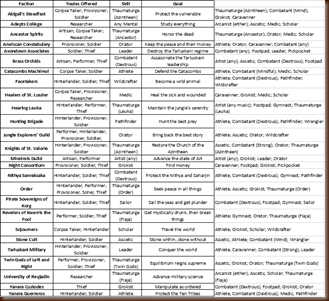
Faction Skills
As I mentioned in the previous post, each faction has a set of affiliated skills. Members of that faction can access training in those skills more cheaply, folks hired from the faction are more likely to have the indicated skills, and advancement in the faction is contingent upon developing them.
Sunday, September 2, 2018
Expanding the Card Mechanic
After teaching my players the Persuasion rules and having them come up several times during the running, I'm pleased to say they worked exactly how I wanted them to, with a few adjustments.
During our discussion after the fact about the new mechanic, one of my players suggested I find other uses for it, other skills that's resolution could best be determined through this card process. We brainstormed a list, and I've now a table that lists each skill and the unique failure conditions for each suite and face card (except for Artist, which will need its own table).
| Caravanner | Mechanist | Persuasion | Ritual Mishaps | Wildcrafter | Wrangler | |
| Hearts | Social | Jam | Bitterness | Changed | Tainted food | Defiant |
| Ace | 4 ranks principle | Lock sealed | New enemy | roll 2d4+2d6 | Half inedible | Cannot be trained |
| King | 3 ranks principle | 4 people to unstick | Followers, hirelings accosted | roll 2d4+1d6 | Third inedible | 4x time to retry |
| Queen | 2 ranks principle | 3 people to unstick | Party waylaid | roll 1d4+1d6 | Quarter inedible | 3x time to retry |
| Jack | 1 rank principle | 2 people to unstick | Reputation tarnished | roll 1d6 | Quarter inedible | 2x time to retry |
| Diamonds | Add card | Break pick | Bribery | Greedy | Misidentified | As hearts |
| Ace | ranks +2 | Break 4 | Bribe as 14 | 4x | All weeds | Unbroken |
| King | ranks +1 | Break 3 | Bribe as 13 | 3x | 75% weeds | 4x time |
| Queen | ranks +1 | Break 2 | Bribe as 12 | 3x | 50% weeds | 3x time |
| Jack | ranks +1 | Break 2 | Bribe as 11 | 2x | 50% weeds | 2x time |
| Clubs | Physical | Noise | Violence | Drained | Broken gear | Feral |
| Ace | 4 ranks principle | 6d6 yards | All-out assault | 1 injury | 8 pieces | Eats people |
| King | 3 ranks principle | 6d4 yards | Kidnapping | Take 3 damage | 6 pieces | Attacks people |
| Queen | 2 ranks principle | 4d6 yards | New faction involved | Take 2 damage | 4 pieces | Afraid of people |
| Jack | 1 rank principle | 4d4 yards | Lodgings assaulted | Take 2 damage | 2 pieces | Retry +1 cards |
| Spades | Mental | Slowed | Negation | Flawed | Infected | As clubs |
| Ace | 4 ranks principle | Quadruple time spent | Negate and duplicate | Higher tier ritual | Take 1 injury | Eats people |
| King | 3 ranks principle | Triple time spent | Negates 3 | All random | Take 3 damage | Attacks people |
| Queen | 2 ranks principle | Double time spent | Negates 2 | Random ritual | Take 2 damage | Afraid of people |
| Jack | 1 rank principle | Double time spent | Negates 2 | Random focus | Take 1 damage | Retry +1 cards |
We'll integrate these into our game the next time we play and see how things turn out.
Sunday, June 10, 2018
Getting Some Help
One of the downsides I did not foresee in allowing each skill to develop individually is that there is now a great deal less incentive for squishier party members to support their comrades-in-arms. In most games, combat is one of the few ways to gain that precious experience commodity (and usually leads to treasure), but combat in Prodigy does not directly offer players rewards. Because of this, the player playing the party's soldier expressed an interest in hiring a pirate goon squad as support.
When I started playing in Alexis's online game, I was surprised that so many of our characters came into the game with people who would fight with us but were not player-characters. I had never seen followers in any other game, period. Our game would be almost impossible without Willa, Valda, Fjall, and Bergthora (RIP, Petar), and acquiring three porters has helped the party quite recently out of a sticky situation. It's inspired a lot of how I think about the role(s) and challenges that player characters can take on, and I'm glad to now have a player prompting me to formulate the rules describing how my players can seek help.
Two skills impact finding and retaining hirelings and followers: Caravanner and Leadership. The Caravanner skill allows the character to find and employ hirelings more effectively, while the Leader skill attracts followers.
Hirelings are people following a character initially because the character is paying them. More highly-skilled individuals command higher rates. Followers, on the other hand, follow a character initially because they feel the leader is worth following. They do not require a monthly stipend, but they also have a lower morale.
Characters seeking to find a hireling will spend at least one day in a city or town looking for candidates. They spend the day(s) talking to their friends, contacts, and others who might know someone looking for a job. At the beginning of this period, the player will need to specify the kind of person(s) they seek. Followers cannot be discovered through this process.
Any character may search for a candidate in the following ways:
Each 1 day spent searching yields 1 person with 3 notches in randomly-determined skills.
Each pair of days spent searching yields 1 person with 3 notches, one of which is guaranteed to be in a specified type of skill (Mental, Physical, or Social)
Every 3 days spent searching yields 1 person with 3 notches, one of whom is guaranteed to have at least 1 notch in a selected skill and 1 notch in another skill of the same type.
A character who is at least an Apprentice Caravanner finds more success: instead of finding a single applicant, they will find an additional number of applicants per 2 notches, rounding down.
Additionally, Apprentice Caravanners may also search for Professionally-skilled people. These will have 2 notches in 2 skills of the same type or different type, determined randomly.
Each week spent searching yields 1 person who is a Professional in a skill of the specified type.
Every two weeks spent searching yields 1 person who is a Professional in the specified skill.
For every 3 notches the character possesses of Caravanner, an additional applicant appears at the end of the search period.
Caravanners with a higher rank will have more options when it comes to selecting applicants and will be able to mitigate hiring limitations (such as looking for folks while not in a major city), but I'll work on those rules later.
Leaders have the opportunity to gain followers whenever they gain a notch. When a character has gained a notch, the next time they spend at least a week in a city or other densely-populated area, they roll 1d3 per notch possessed. If that total is greater than the number of followers they currently possess, they gain followers equal to that difference.
Follower and hirelings expect that their employers will provide for food and lodging. Usually, they will act under the control of the hiring character's player, but they will refuse orders that appear nonsensical or suicidal. I use Alexis' morale rules because they are really good, with the slight alteration that 'combat training' refers to a notch in the Combatant skill.
When I started playing in Alexis's online game, I was surprised that so many of our characters came into the game with people who would fight with us but were not player-characters. I had never seen followers in any other game, period. Our game would be almost impossible without Willa, Valda, Fjall, and Bergthora (RIP, Petar), and acquiring three porters has helped the party quite recently out of a sticky situation. It's inspired a lot of how I think about the role(s) and challenges that player characters can take on, and I'm glad to now have a player prompting me to formulate the rules describing how my players can seek help.
Two skills impact finding and retaining hirelings and followers: Caravanner and Leadership. The Caravanner skill allows the character to find and employ hirelings more effectively, while the Leader skill attracts followers.
Hirelings are people following a character initially because the character is paying them. More highly-skilled individuals command higher rates. Followers, on the other hand, follow a character initially because they feel the leader is worth following. They do not require a monthly stipend, but they also have a lower morale.
Characters seeking to find a hireling will spend at least one day in a city or town looking for candidates. They spend the day(s) talking to their friends, contacts, and others who might know someone looking for a job. At the beginning of this period, the player will need to specify the kind of person(s) they seek. Followers cannot be discovered through this process.
Any character may search for a candidate in the following ways:
Each 1 day spent searching yields 1 person with 3 notches in randomly-determined skills.
Each pair of days spent searching yields 1 person with 3 notches, one of which is guaranteed to be in a specified type of skill (Mental, Physical, or Social)
Every 3 days spent searching yields 1 person with 3 notches, one of whom is guaranteed to have at least 1 notch in a selected skill and 1 notch in another skill of the same type.
A character who is at least an Apprentice Caravanner finds more success: instead of finding a single applicant, they will find an additional number of applicants per 2 notches, rounding down.
Additionally, Apprentice Caravanners may also search for Professionally-skilled people. These will have 2 notches in 2 skills of the same type or different type, determined randomly.
Each week spent searching yields 1 person who is a Professional in a skill of the specified type.
Every two weeks spent searching yields 1 person who is a Professional in the specified skill.
For every 3 notches the character possesses of Caravanner, an additional applicant appears at the end of the search period.
Caravanners with a higher rank will have more options when it comes to selecting applicants and will be able to mitigate hiring limitations (such as looking for folks while not in a major city), but I'll work on those rules later.
Leaders have the opportunity to gain followers whenever they gain a notch. When a character has gained a notch, the next time they spend at least a week in a city or other densely-populated area, they roll 1d3 per notch possessed. If that total is greater than the number of followers they currently possess, they gain followers equal to that difference.
Follower and hirelings expect that their employers will provide for food and lodging. Usually, they will act under the control of the hiring character's player, but they will refuse orders that appear nonsensical or suicidal. I use Alexis' morale rules because they are really good, with the slight alteration that 'combat training' refers to a notch in the Combatant skill.
Thursday, May 17, 2018
Uses for Entertainment Blocks
In Alexis' block model, each block needs to have some benefit for characters who spend the day there. Some of these benefits are fairly straightforward, such as healing faster by the beach. Some are perhaps less so. Entertainment blocks, those centered around arenas, casinos, or theatres, don't obviously provide a function not shared with relaxing blocks like the careenage or a bathhouse. If we combine them with Alexis' rules for art, something pops out rather immediately: spending a day in an entertainment block grants experience of some sort.
As I don't use traditional leveling and experience totals, preferring my own system, I need a little more specificity.
In case you didn't click the link, each skill in Prodigy has its own experience track, measured in notches. Proficiency with a skill increases based upon the number of notches possessed. Characters normally gain notches through training, by they can also gain them in the heat of the moment via a 'Flash of Insight'. Each critical (success or failure) gives the character one tally. When the number of tallies exceeds the number of notches, the character gains a notch (although this cannot be how the character gains their first notch in the skill).
Each skill has at least one descriptor, mental, physical, or social, based upon the way(s) it is used - fighting skills are physical, speechcraft is social, etc. Spending a day in an entertainment block grants a tally in a random skill with the appropriate descriptor. Places like arenas, sporting fields, or the construction sites of large buildings grant physical skill tallies. Casinos grant social skill tallies, while theatres and music venues might grant either social or mental skill tallies. Storytellers and libraries grant mental tallies. Traveling jongleur troop performances (akin to stereotypical Roma shows) offer a flash of insight in any skill.
It is important that the tally gained is random, but I'd allow players to pick the descriptor if more than one is available.
As I don't use traditional leveling and experience totals, preferring my own system, I need a little more specificity.
In case you didn't click the link, each skill in Prodigy has its own experience track, measured in notches. Proficiency with a skill increases based upon the number of notches possessed. Characters normally gain notches through training, by they can also gain them in the heat of the moment via a 'Flash of Insight'. Each critical (success or failure) gives the character one tally. When the number of tallies exceeds the number of notches, the character gains a notch (although this cannot be how the character gains their first notch in the skill).
Each skill has at least one descriptor, mental, physical, or social, based upon the way(s) it is used - fighting skills are physical, speechcraft is social, etc. Spending a day in an entertainment block grants a tally in a random skill with the appropriate descriptor. Places like arenas, sporting fields, or the construction sites of large buildings grant physical skill tallies. Casinos grant social skill tallies, while theatres and music venues might grant either social or mental skill tallies. Storytellers and libraries grant mental tallies. Traveling jongleur troop performances (akin to stereotypical Roma shows) offer a flash of insight in any skill.
It is important that the tally gained is random, but I'd allow players to pick the descriptor if more than one is available.
Wednesday, June 29, 2016
A New Skill System
Prodigy, like GURPS
and Runequest, is a fully skill-based system, using the same skill mechanic for
almost every mechanical test undertaken by the players.
There are four skill
systems that I've seen used - d20, 3d6, %, and dice pools. The d20 system works by rolling 1d20, adding
modifiers, and then checking the modified result against a target number
determined by the task itself. What's
nice about this system is that the difficulty of the task is directly
incorporated into the check, as is the character's skill. However, the d20 roll is hugely variable, and
the chance of critical failure and success are the same no matter one's level
of skill.
The 3d6 system (and
OD&D's ability score checks work the same way) require rolling your dice
(3d6 or d20) under a number determined by the character's proficiency with the
skill: so a GURPS character with an 11 Merchant skill would need to roll an 11
or less with 3d6 to succeed a given check.
The bell curve provided by the 3d6 means that results are generated much
more reliably. However, the mechanic
does not provide a transparent way of incorporating the difficulty of the task
into the check itself - you can add modifiers to the character's skill, but it
is a very ad-hoc way to do this.
The percentile
system combines some of both of the previous two approaches: characters' skills
are ranked 1 to 100. To test a skill,
percentile dice are rolled, and the check succeeds if the dice roll under the
character's skill level. There are some
cool number games that can be done here, like special effects on doubles rolled
under or over a character's skill level and so on, but it combines the wide
variability of the d20 with the fixed difficulty of the 3d6, and so has the
aspect from each previous system I most dislike.
The dice pool system
gives the player a number of dice equal to their level in the skill, and
assigns a strict possibility of success (say 8, 9, or 10 on a d10 or 6 on a
d6), with more beneficial results occurring when more successes are rolled. Thus, a player rolling three d10s might think
they have a fairly good chance of getting at least one success. The odds of success, though, are deceptive
(rolling three d10s with success on an 8, 9, or 10 conveys only a 65% chance of
any successes, with 4 dice bringing the chance only to 75%), and the system has
the highest degree of variability of all the systems, since dice that don't
succeed are either merely useless or actively bad (if they roll a failure).
Now, I feel that as
one becomes more accomplished with a skill, not only can they accomplish more
difficult tasks, but they can also accomplish all tasks more consistently. I also want my system to be able to concretely
incorporate the difficulty of whatever task a player attempts - I want
challenging tasks to be challenging and easy tasks to be easy, and I want both
of those things to happen with a minimum of ad-hoc adjustments. I also want it to be fairly uncomplicated -
no involved table lookups or complicated math.
The way I've
accomplished this is by combining many of the approaches together. As I've said before, I rank a character's
level of skill in one of 6 tiers: Novice, Apprentice, Journeyman, Specialist,
Master, and Grandmaster.
|
Skill tier
|
Dice Rolled
|
Difficulty Value
|
|
Novice
|
1d6
|
6
|
|
Apprentice
|
1d6+1d4
|
9
|
|
Journeyman
|
1d6+2d4
|
12
|
|
Specialist
|
2d6+2d4
|
15
|
|
Master
|
2d6+3d4
|
18
|
|
Grandmaster
|
3d6+3d4
|
22
|
This approach
borrows from the dice pool system in that as more skill is obtained more dice
are rolled. However, unlike the dice
pool system, all dice matter - they are summed together and checked against the
task's difficulty value. Because more
dice produce a stronger bell curve effect, the expected value of each die roll
is 3 less than the difficulty value of a task of equal tier (because of adding
in aptitudes, which are scaled from 1 to 6), which means that increasing skill
not only increases the overall total, but it also increases consistency when
performing tasks. Lastly, by assigning
difficulty values for targets, the task attempted by the character now
absolutely factors into the test.
Moreover, when
circumstances change, I can alter the difficulty of the test in one of two
ways: I can add or subtract 1 to the DV for minor things or I can change the
tier of challenge for larger difficulties.
My options for changing the circumstances of the die roll are restricted
because of this tiered system.
While I've yet to
run a real game with these rules, I've run several oneshots and combat
scenarios, and the mechanic has worked exactly as I like it to, but I'd welcome
any thoughts folks have on it.
Subscribe to:
Posts (Atom)