Showing posts with label World Info. Show all posts

Friday, June 14, 2019

A New Beginning

About two weeks ago, I shuttered development on the Sea of Shadows. Questions of cultural appropriation had hounded me from the beginning, but seeing JB's new project, I realized that 1) the Sea of Shadows was, no matter my care and attention to detail, an appropriative project and 2) there are some phenomenal designers already working on places and spaces like what I wanted the Sea of Shadows to be (Zedeck Siew's and Munkao's http://athousandthousandislands.com/ is an excellent example). I felt an ethical need to refocus my (colonizing) attention away from the Sea of Shadows. I'd love to return there with other, better qualified designers, but that is a dream for another time.

Instead, I have started work on a new region within the same world: Gelgelim, from the Hebrew word for wheels. As a Jew and a Pole, there is a vast treasury of Slavic, Ashkenazi, and Polish folklore that is weird and interesting and worth exploring. My players agreed to take the plunge with me and we created new characters and begun a new game within Gelgelim a couple of weeks ago.

The following is the description of the setting as it appears in the Core Book. I'll have posts on bears, birds, boginky, bells, and kabbala coming out in the next week or so (I'm on a half-vacation with WiFi, so I've the time to bang all of this out).

“Gelgelim channels Polish, Slavic, and Ashkenazi lifeways with a dollop of Irish and Welsh folklore into an area some 360,000 square miles large (about the size of Germany or Japan). To the north lie the toxic ruins of the Azintheen Empire, filled with bronze monstrosities and powerful magics. The rugged lands to the west resist exploration. And Chornilis, the black woods, blocks southward and eastward travel.

“The time is a century after the Scorching, a man-made cataclysm that destroyed the Azintheen Empire, boiling the land and souring the sea. In Gelgelim, the forest responded to the Scorching by expanding hundreds of hectares in a single day, consuming towns and cities and blocking passage east. The remaining towns and villages of Gelgelim have yet to fully recover. Toxic ashfalls and contaminated water have claimed many a would-be explorer, and the bears roaming wild have claimed many more.

“For money, fame, power, or the good of your village, you have decided to brave these dangers and explore the wilds. Good luck.”

Friday, April 12, 2019

Cultural Capitals

[This is an excerpt from the Prodigy Book]


Prodigy takes place in and around the Sea of Shadows, a mystical place south of the equator, where myths and legends lurk just beyond city gates. This world is diverse in peoples, places, creatures, and beliefs. Consequently, there are many ways to wealth and secrets to uncover for the bold and clever.


         For ease of use, the Sea of Shadows divides into several cultural capitals, urban locations that represent the confluences and conflicts present within the game’s setting. Chapter 14 discusses each in more detail. Games should start in or near one of these cities, moving elsewhere as the players desire.

Blyth is a hotbed of anti-Tarluskani activity. Rebels flock to the city, whose Tarluskani overlords grow increasingly draconian in response.

The Catacombs are the underground holt of the Archivist people and home to the best libraries and research apparatus imaginable. The Catacombs sponsors teams of scholar-explorers to acquire new knowledge and bring it home.

Glenden Wood is the home of vice and free enterprise. Almost anything imaginable can be found there, for a price.

Hackerith Hill straddles the two territories of the Tarluskani Empire: the Khanite cities and Deliverance. Yet its proximity to the jungle and Nithya have weakened the Tarluskani Empire’s hold over the city.

Jask is home to a deeply divided Tarluskani population. Many have grown comfortable in their role as people of property and bureaucratic power, but nostalgia for a nomadic past is rapidly rising. The enslaved Khanites sit precariously between these two factions.

Korg hosts the dreaded Pirate Sovereigns of Korg, with their gem-hued magics, who protect the islands from the Tarluskani’s advances yet also terrorize the indigenous peoples who were there first.

Ophir is the largest city on the Wildlands, the capital of the Yanera tribes, and one of the few places in the savannah welcoming of foreigners.

Reyjadin, once named Avondon, is the heart of the Tarluskani Empire’s expansionary efforts. The Tarluskani reforms have brought new wealth and prosperity to the city, some of which have trickled down to its inhabitants.

Sha’aryam is both a ruined Azintheen city and the nearby encampment. Glory seekers brave the city’s metal defenders for untold wealth and long-lost technologies.

Tarlusya, capital of the Tarluskani Empire, is a decadent place, having grown fat from the sweat and blood of the enslaved Khanites.

Yrsh sits on Saharjin’s edge and is just as mercurial as the magical rainforest. The jungle’s ever-present threat has forced an uneasy alliance between the Tarluskani authorities, Nithya forest-worshippers, and Azintheen explorers.

Wednesday, October 17, 2018

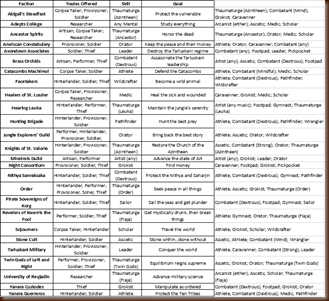
Faction Skills

As I mentioned in the previous post, each faction has a set of affiliated skills. Members of that faction can access training in those skills more cheaply, folks hired from the faction are more likely to have the indicated skills, and advancement in the faction is contingent upon developing them.


image

Saturday, September 8, 2018

The Tarluskani Empire


Half a century after the Scorching, a man named Isram united the Tarluskani tribes dwelling in the desert north of the Khanates. He named himself Warlord Isram and directed his horde southward, conquering the city-states and enslaving the populace.

After the Khanite subjugation, Isram transitioned to Reyja, declaring her rule the first of the Tarluskani Empire. She gave the tribes of her most trusted supporters command over a city each before marching her forces south through Saharjin to invade Deliverance. She perished in the siege of Avondown, Deliverance’s final stronghold, and her wife’s ward, Arbab, took command of the Empire. They renamed Avondown ‘Reyjadin’ in Reyja’s honor and distributed command of the newly-conquered provinces over to their most trusted generals before returning to the Empire’s capital, Tarlusya.

The Empire resembles a constellation of loosely-aligned districts, each governed by a single tribe. While all pay fealty to Emperor Rajj, the tribes frequently squabble with each other when unsupervised. Each tribe has a specific glyph marking their flags, armor, and official seals.

A Tarluskani’s tribal heritage is central to their identity. It determines their allies, their enemies, and their sacred stories. Acting honorably is crucial; their behavior reflects on how others will view their tribe. Disputing a Tarluskani’s honor can only be resolved with a swift apology or a duel to the death. Disrespecting an entire tribe usually leads to a far more unpleasant fate.

While most in Deliverance avoided slavery, almost all in the former Khanite city-states are still enslaved. Non-ethnic Tarluskani, both slaves and freefolk, can join a tribe through a decade of military service to the Empire.

The Islands of Korg


The islands of Korg stand between the Sea of Shadows and the wide ocean beyond. When the Tarluskani invaded the Azure Sultanate, the surviving Khanite bureaucrats and merchants fled to Korg. There, they established an independent principality, sustained through piracy. These immigrants became the Pirate Sovereigns of Tal Afar. While they initially preyed only on Tarluskani vessels, their principles have eroded with time.

          The Pirate Sovereigns keep to themselves, playing intrigues against one another and plotting the next big adventure, leaving the ordinary folks in Korg free to do whatever they please. Consequently, no one in Korg cares what or how someone fucks, provided they do not make a mess. As emotional attachments provide an obvious vulnerability, those in committed relationships (queer or otherwise) work to keep them quiet.

          As the center for piracy, Korg caters to a rough crowd. While many children are born in Korg, few survive to adulthood. Those that do were often nourished on the tall and not-so-tall tales traded among the more seasoned pirates.

The Khanates

As a reference for my players, I'm posting publicly some general overview information about each of the large regions they currently know about.


North of Saharjin, but south of the northern desert lies a constellation of city-states known as the Khanates. While currently the seat of the Tarluskani Empire, before the Scorching these cities were part of the Azure Sultanate. A Khan ruled each city-state, advised by an army of ministers. Constantly feuding, each city vied for influence with both the Azure Sultan and the mystic Threnna peoples from Saharjin. The Tarluskani took advantage of the Scorching’s devastation and quickly overran the city-states, enslaving all their citizens.

All Khanites are branded, usually on their forehead or cheek. Slaves have three choices: toil in slavery until death, enlist in the Tarluskani military to be freed after ten years, or escape and flee slave-catchers forever. Escaped or freed slaves often hide their tattoo with scarring or a new tattoo.

Most Khanites have adopted the customs and dress of the Tarluskani and study the Myths of Fiája. Consequently, little remains of the culture of the Azure Sultanate. Some activists work to revive the practices of the Azure Sultanate, but the Tarluskani government takes a dim view of such efforts.

Wednesday, October 19, 2016

The Chupacabra

Well, I''m not really a radical, I guess, so there's that.

Anyway, here's the first draft of a monster entry - the Chupacabra.  In an ideal world, each creature gets its own page, including art, statblock, and description.  We'll see - I may need to give each creature two pages to fit in all of the content that I want.

I'd appreciate input on this - for obvious reasons, I keep the bestiary a secret from my players, which means that I'm the only person who's seen this, until now.

Chupacabra


“We were probin Sahargeen’s edge, tryin to see how far round she went.  One a the erlier xpaditions.  Sommat spooked the pack donkeys and they near draged the handler off wiff em.
“Jus then a big critter, wiff long spines on s back, came chargin out a the trees.  We gave chase n folowd it.  We ran and ran.  Fainly we caw up tu it in a clearin.  It had long fangs covered in donkey blood and a cupl a our donkeys lay bleedin’ on the dirt.  Must a bin scared by all of us shoutin’, cuz right then it ran out on us.” – PM

“The species colloquially called chupacabra are primarily found in flatland and hill environments, where their dun-colored skin patterns allow them to blend in with the shrub vegetation.  They stand approximately 2 yards tall and weigh somewhat more than a human male, resembling them in gross anatomical features.
“Dissection revealed both the fangs and claws of this creature are capable of wicking blood out of scratched or bitten creatures, potentially causing fatigue from blood loss.  Overall muscle density is quite high.  Presumably, the back spines are vestigial – they appear to be a hardened cartilage substance, not bone, and therefore do not serve any real offensive or defensive purposes.
“Behavioral studies are few and far between – most creature research teams are forced to put the beasts down before bringing them back to the Catacombs for full experimentation.  It would appear, though, that their pain tolerance is fairly normative, despite their fierce appearance.
"More research is also required to fully investigate the reproductive cycles and mating behaviors of this species." - TAS

Wednesday, August 31, 2016

Mushi

Mushi-shi is one of my favorite anime series ever, right up there with Moribito: Guardian of the Spirit.  While Moribito is an amazing example of how I want my D&D games to feel, Mushi-shi has an absolutely captivating world, full of wonder at the mysteries of the world.  The protagonist, Ginko, exists apart from, yet observing human society, full of its struggles and troubles, and the series showcases humanity's potential for nobility and cruelty through Ginko's impartial eye.

The core of each episode, and the key to the amazing feel of the world (beyond the visuals) is the existence of mushi, a category of animal in Japanese that is now translated as 'bugs'.  However, 50+ years ago, mushi corresponded to a broader category - all of the strange creatures that wouldn't fit in the other categories.  Snakes and beetles and worms and frogs and spiders and all of the slimy, gross, terrifying creatures were lumped into this category of mushi, the history of which actually goes all the way back to antiquity, as an analogous character is actually found on the Shang Dynasty oracle bones, one of the oldest records of the Chinese language.

In a D&D context, mushi provide a wholly neutral set of entities that exist in both the natural and supernatural worlds.  While I can't use any of the mushi presented in the show for my Bestiary, the idea of similar creatures is captivating.

So, here's a list of mushi that eat specific things (and would therefore be noticeable by the absence of the thing or the presence of its opposite).

Eats thoughts
Eats pain
Eats laughter
Eats smoke
Eats dead growth
Eats sunlight
Eats darkness
Eats starlight
Eats firelight
Eats strong feelings
Eats alcohol
Converting alcoholic beverages into foul-tasting drinks that might spread disease
Eats bodily fluids (pus, blood, urine, etc.)
Outputs healing elixir
Eats hair
Eats memories
Eats silver
Eats gravity
Psychically links people - if too far apart, one is ripped from their body to watch the other as a ghost
Eats salty water
Can attach to people, growing like a wart
Eats harmony (overtones)

Eats dry weather

Saturday, August 27, 2016

Map Update

Lacking extensiveprogramming know-how, I am making my map by hand.  I finished most of the inhabited portions today and I wanted to post a picture.  There is still a great deal to do - I have cities to name, borders to draw, and chains of arrows to turn into rivers, but for the first time I have a visual representation of the world in which my characters will play.  It is immensely satisfying, to say the least.


I wrote previously on my methods for creating this map - taking a complete map, obfuscating it into large chunks, and then decompressing the chunks back into the map - and now I can talk about how the maps compare.  If you compare the first map to the latest one, you'll notice some vertical distortions due to mislabeling hexes when I first started.  I realized my mistake after 20 hours of work and decided that I liked the bays and inlets more than the original, flatter coastline.  I think the big difference between the two maps is that the second one is much less linear (which makes sense) - terrain is broken up into like chunks instead of radiating lines of topological features.  This was the objective of the whole process, but what is really nice is the gradation between the different chunks - while there are some areas that are very obviously distinct, especially in the southern half of the map, terrain blends across the chunk borders.


I am happy with the result, but I doubt I'll do it again.  I had a very specific shape in my head for the Sea of Shadows that I wanted to realize, which led me to the extensive drafting and mapping process I used.  For the other regions that I will make in the future - Panumbra, the Frozen South, and Guol, I have very few geographic ideas and so I'll probably just let Alexis' RNG process work its magic.

Saturday, July 16, 2016

The Brass Orchids

I'm taking a brief break from my Bard series to write about one of the factions in my world.  It's the least 'traditional' of all the factions, and it's been tricky to wrap my head around them.

First, some background information.  Before the Tarluskani invaded and founded the Tarluskani Empire, the Confederacy was home to 30 feuding city-states.  The region was resource-abundance and the wars were petty affairs, so life in the cities was very stable.  Because of the stability and prosperity of the area, urban folks had the time and resources to support the arts - architecture, ceramics, cooking, drawing, literature, music, performing arts, sculpture, and swordplay, and artists would often compete to bring pride to their home city-state.

When the Tarluskani invaded, they banned representational art and enslaved the entire population.  However, the artistic class still existed, just driven underground.  Using their art to embolden the spirit of the enslaved Confederates and strike back against their Tarluskani oppressors, the Brass Orchids (name stolen from Delaney's Dhalgren) were founded as an artistic resistance movement, creating massive murals overnight and sneaking instruments and figurines into slave pens all over the Confederacy.  Just creating art would not be enough, they knew, and so the duelists became assassins, striking down Tarluskani who abused their slaves and high-ranking military targets.

The faction is essentially a decentralized terrorist organization that sees itself as the defenders of an indigenous way of life uprooted by the Tarluskani some 80 years ago.  The bulk of the enslaved populace have acclimated to their slavery and while some see the Brass Orchids as young firebrands who mean well but only bring trouble down upon the very people they claim to protect, most see them as a threat more dangerous than their predictable Tarluskani masters.  More than anything else, the Brass Orchids are an ideology to which any can claim adherence.

They have vibes of the student's rebellion as expressed in Les Miserables with tinges of Modernist art - in other words, they are an organization entirely at odds with the early-Renaissance aesthetic of the rest of my world (along with the other terrorist organization, the Avondown Associates).  However, despite the anachronism, it is important to keep them.

The Avondown Associates are a group of Southerners, mostly former thieves, who are attempting to oust the Tarluskani from their city, now renamed Reyjadin.  When I first introduced my players to the world of Prodigy, I gave my party good reason to join them.  The slow realization that the party had aided and abetted racially-motivated terrorism (since the Southerners and Tarluskani are different ethnicities) made them incredibly uncomfortable, and it is important that my world be able to put players into that kind of position and force them to grapple with this issue, especially today, when terrorism has become a part of the Western consciousness.

Alexis recently wrote about the Senegalese slave trade and addressed placing the cruel realities often found in the real world within the game one.  I agree with him.  One of the central themes of the world of Prodigy is cultural intersection, which happens both positively and negatively.  It presents (and creates) gross injustices that a civic-minded party has to grapple with, and I've tried to give every culture, every faction, both a positive and a negative aspect.  The Brass Orchids are freedom fighters seeking a better world for the Confederates and are the only 'organization' in the world of Prodigy that sees art as more than mere entertainment (and would be able to take advantage of the work on bards I'm doing right now).  They can also be cruel and callous killers, willing to let the repercussions of their actions fall upon their people for the 'greater good'.  The party gets to decide whether the one balances the other, or not.

Wednesday, April 6, 2016

List of Magical Herbs

This will probably be the first post that will be useful to someone not playing in my world.  I've been fascinated by the magic powers attributed to herbs just about forever, and since I now have a number of players in my world who are playing nature-affiliated characters, it was time to apply all of my research into something gameable.

This is a list of 100 (that happened by accident) herbs listed alphabetically along with their associated magical effects.  I don't have mechanics for each of the effects, but most of them are fairly self-evident.

Now, whenever my players forage for herbs, I'll have them roll to see what they discover.  The herbalism skill will then grant them access to both more effects for each herb as well as having each effect be more potent.

EDIT: I've removed the original (essentially unreadable) table in favor of this picture instead, which should be much more legible.


Placing References


Alexis recently finished a series of posts detailing (mostly) his world's economic system.  I've been salivating over it for years, and I immediately set to establishing it in my world.

I immediately ran into some problems specific to my world.  The problems begin in that my world (at least, the parts that I have designed right now) take place on the equator - Sahargeen, the magical rainforest, is on the equator and therefore the Southern Kingdoms, which lie directly south of it, are in a tropical climate.  This means that the Southern Kingdoms have been carved out of this rainforest, (and the land is mostly hilly, I'll get to that later), rendering it less suited for a standard D&D economy - horses do very poorly in jungle, as does grain.

To place resources, I decided to type each hex in two ways: its topography and vegetation, since the two can be independent.  Here, the vegetation is all jungle or jungle and swamp (for the hexes featuring rivers), and the topography is almost entirely hilly (since I started with elevations for each hex instead of a terrain type, I had to come up with some rules to apply a topographic type to each hex.  My rule of thumb is that if there is an elevation change of more than 500', then both hexes will be hilly, and mountains are determined by either hills over 5000' or a difference of more than 2000').

Each topographic and vegetative option has a distinct set of references that might be found there:
Type
Hills; Jungle
Hills; Jungle Swamp
Plain
Plain; JS
Mountain; J
Coast
1
Empty
Empty
Empty
Empty
Empty
Empty
2
Empty
Empty
Empty
Empty
Empty
Roll twice
3
Roll twice
Roll twice
Roll twice
Roll twice
Roll twice
Salt
4
Ore
Ore
Cattle
Cattle
Gold
Fish
5
Bricks
Bricks
Grain
Grain
Ore
Clay
6
Sheep
Clay
Fruit
Fruit
Bricks

7
Clay
Fruit
Horses
Horses


8
Fruit
Empty
Bricks
Bricks


9
Empty
Fruit

Empty


10
Fruit
Spices

Fruit


11
Spices
Timber

Spices


12
Timber
Fish

Fish


13
Gold
Gold


Coasts are (obviously) the hexes that border the sea.  Since I rolled randomly on the table you see above for each hex, I had to essentialize my list to make sure that each area was producing the kinds of things I wanted it to produce - I want coasts to produce primarily salt and fish, and so I ignore whatever vegetation might be there in favor of the opportunities provided by the topography.  Similarly, since having a lot of gold references is important to standardize pricing, I wanted mountains to predominantly offer gold and ore, so I ignore vegetation there, as well.

You'll also notice that I do not have any grapes references as mentioned in Alexis' original setup.  This is because grapes require a hot, dry climate to thrive, but in the tropics, bananas, coconuts, and pineapples serve the same purpose (the brewing of wine).

The table worked fairly well for this area, and once I finish the Southern Kingdoms up, I'm interested in expanding this method to work with my other regions (which are much more vegetatively diverse).  I will probably make them produce fewer resources, as well.

Part of the reason I have for a much higher chance of producing references than not is that the Southern Kingdoms are the player's entry point into my world - it is my Fallow, to draw from Alexis' How to Run.  The culture is based on a European religio-feudal model despite being on the edge of a tropical jungle (they are immigrants), and I want this area, therefore, to be incredibly resource-rich.  The randomization, as you will soon see, still makes relative scarcity occur, but most of the reference types are well-represented, so one can purchase most goods for a reasonable price (the exceptions being horses, cattle, and grain).

Hex
-16
-15
-14
-13
-12
-11
-10
-9
-8
-7
-6
-5
-4
-3
-2
-1
0
1
2
3
4
5
6
7
8
7
?
Hills; J
?
?
?
?
Hills; J
?
?
?
Hills; JS
?
Hills; J
?
Hills; J
?
Hills; J
?
?
?
Hills; J
?
Hills; J
?
Hills; J
6
Hills; J
Hills; J
Hills; J
Hills; J
Hills; J
Hills; J
Hills; J
Hills; J
Hills; JS
Hills; JS
Hills; JS
Hills; JS
Hills; JS
Hills; JS
Hills; JS
Hills; J
Hills; JS
Hills; J
Hills; J
Hills; J
Hills; JS
Hills; J
Hills; JS
Hills; JS
Hills; J
5
Hills; J
Hills; J
Hills; J
Hills; JS
Mountain; J
Mountain; J
Mountain; J
Hills; J
Hills; JS
Hills; J
Hills; JS
Hills; JS
Hills; JS
Hills; J
Hills; JS
Hills; J
Hills; JS
Hills; J
Hills; J
Hills; J
Hills; J
Hills; J
Hills; JS
Hills; J
Hills; JS
4
Hills; J
Hills; J
Mountain; J
Hills; JS
Hills; JS
Hills; JS
Mountain; J
Hills; JS
Mountain; J
Hills; JS
Hills; JS
Hills; JS
Hills; J
Hills; JS
Hills; JS
Hills; J
Hills; JS
Hills; JS
Hills; J
Hills; JS
Hills; JS
Hills; JS
Hills; JS
Hills; J
Hills; JS
3
Hills; J
Hills; J
Mountain; J
Hills; JS
Hills; JS
Hills; JS
Hills; J
Mountain; J
Hills; J
Hills; JS
Plain; JS
Hills; J
Hills; J
Hills; J
Hills; JS
Plain
Plain; JS
Hills; JS
Hills; JS
Hills; J
Hills; J
Hills; JS
Hills; JS
Hills; JS
Hills; J
2
Hills; J
Hills; JS
Hills; JS
Hills; J
Hills; JS
Hills; JS
Hills; JS
Hills; JS
Hills; JS
Hills; J
Plain; JS
Hills; J
Hills; JS
Hills; JS
Hills; J
Hills; J
Plain; JS
Hills; JS
Hills; JS
Hills; J
Hills; JS
Hills; J
Hills; JS
Hills; JS
Hills; J
1
Hills; J
Hills; JS
Plain; JS
Hills; J
Coast
Hills; JS
Hills; J
Hills; J
Plain; JS
Plain; JS
Coast
Hills; JS
Hills; J
Plain; JS
Plain; JS
Hills; JS
Coast
Hills; JS
Hills; J
Hills; JS
Hills; J
Hills; JS
Hills; JS
Hills; J
Mountain; J
0
Coast
Hills; J
Coast
Plain
Coast
Coast
Hills; J
Hills; J
Hills; J
Coast
Sea
Coast
Coast
Plain
Coast
Coast
Sea
Coast
Hills; JS
Hills; JS
Hills; JS
Hills; JS
Hills; J
Hills; JS
Hills; JS
-1
Plain
Coast
Plain
Coast
Sea
Sea
Coast
Plain
Coast
Coast
Sea
Sea
Sea
Coast
Sea
Coast
Sea
Coast
Plain; JS
Hills; J
Hills; JS
Hills; JS
Hills; JS
Hills; JS
Mountain; JS
-2
Coast
Plain
Coast
Sea


Sea
Coast
Coast
Sea


Sea

Sea
Sea
Coast
Hills; J
Hills; J
Hills; JS
Plain
Hills; JS
Hills; J
Mountain; J
-3
Sea
Coast
Sea


Sea
Sea


Sea
Coast
Hills; J
Coast; JS
Plain; JS
Plain
Hills; JS
Hills; JS
-4

Sea


Sea
Coast
Sea
Coast
Coast
Hills; JS
Hills; J
-5


Sea

Sea
Sea
Hills; J
Hills; JS
-6


Sea
Coast
Hills; JS

This table lists all of the hexes that I consider within the boundaries of the Southern Kingdoms.  Each 20-mile hex has its own box, and (once I get back to my more powerful computer) I'll assign each hex to a market.  The question marks are areas for which either I couldn't read the elevation or I haven't mapped yet, but they are too far from the Southern Kingdoms to provide references.

This area spans about 100,000 square miles and has 26 markets, concentrated within about 80 miles of the coast.

After randomly determining my references via the process above, I come out with the following list.

Hex
-16
-15
-14
-13
-12
-11
-10
-9
-8
-7
-6
-5
-4
-3
-2
-1
0
1
2
3
4
5
6
7
8
7
?
Clay
?
?
?
?
Empty
?
?
?
Empty
?
Timber
?
Clay
?
Empty
?
?
?
Spices
?
Ore
?
Empty
6
Bricks
Fruit
Spices
Spices
Empty
Ore
Fruit
Fruit
Spices
Spices
Fish
Fruit
Empty
Spices
Empty
Fruit
Fruit
Sheep
Empty
Bricks, Fruit
Gold
Fruit, Bricks
Empty
Spices
Spices
5
Ore
Bricks, Ore
Empty
Timber
Timber
Ore
Gold
Fruit
Spices
Timber
Bricks
Fruit
Timber
Ore
Gold
Bricks
Bricks
Empty
Fruit
Sheep
Fruit
Sheep, Fruit
Ore
Empty
Fruit
4
Empty
Gold
Timber, Spices
Ore
Fish
Horses
Ore
Fruit
Gold
Empty
Clay
Empty
Fruit
Bricks
Empty
Timber
Fruit
Ore, Fruit
Timber, Ore
Gold
Fruit
Fruit
Gold
Empty
Empty
3
Fruit
Fruit
Fruit
Bricks
Fish
Bricks
Empty
2 Gold
Fruit
Ore
Horses
Empty
Fruit
Gold
Gold
Empty
Cattle
Bricks, Gold
Empty
Clay
Gold
Fruit
Empty
Clay
Spices
2
Bricks
Ore
Fish, Fruit
Sheep
Gold
Fruit
Timber
Spices
Timber
Fruit, Spices
Bricks
Timber
Bricks
Ore
Clay
Spices, Timber
Spices
Empty
Clay
Timber
Fruit
Bricks
Timber
Empty
Empty
1
Timber
Bricks
Horses
2 Fruit
Salt
Spices, Fruit
Empty
Fruit
Spices
Bricks
Salt
Spices
Empty
Horses
Empty
Empty
Clay
Timber
Empty
Empty
Timber
Empty
Fruit
Timber
Gold
0
2 Salt
Empty
Fish
Empty
Salt, Fish
Salt
Fruit
Clay
Bricks
Fish
Sea
Clay
Salt
Empty
Salt, Fish
Salt
Sea
Empty
Fish
Fruit
Fruit
Spices
Bricks, Timber
Timber
Spices
-1
Bricks, Grain
Salt
Empty
Fish, Salt
Sea
Sea
Empty
Bricks
Empty
Fish
Sea
Sea
Sea
2 Clay
Sea
Clay
Sea
2 Fish
Fish
Bricks
Ore
Bricks
Ore
Fish
Gold
-2
Salt
Empty
Empty
Sea


Sea
2 Salt
Fish, Salt
Sea


Sea

Sea
Sea
Clay, Fish
Fruit
Spices
Fruit
Cattle
Spices
Clay
Empty
-3
Sea
Empty
Sea


Sea
Sea


Sea
Salt
Sheep, Timber
2 Clay
Fish
Bricks
Empty
Spices, Fruit
-4

Sea


Sea
Salt, Fish
Sea
Empty
Salt, Clay
Clay
Gold
-5


Sea

Sea
Sea
Fruit
Empty
-6


Sea
Empty
Fish, Clay

My count of each reference is as follows:
Reference
Totals
Bricks
23
Cattle
2
Clay
19
Fish
21
Fruit
43
Gold
19
Grain
2
Horses
2
Ore
16
Salt
18
Sheep
5
Spices
18
Timber
21

Fruit, then, is the dominant foodstuff, and there's a fair amount of stone, fish, gold, salt, timber, and spices.  The relative scarcity of timber indicates that, although the rainforest is everywhere, most of the wood in the rainforest isn't useful for construction purposes (or the forest's guardians have killed enough would-be loggers that people have learned their lesson).

The lack of grain, however, will be problematic - grain forms a huge staple in most standard medieval diets (especially nonperishable rations, which are kind of important for roleplaying games).  To fix this, I'll go in as I'm assigning hexes to markets and change what references are produced by the plains in columns -6 and 0.

I can already see how this is going to change my game for the better, and I'm excited to implement everything.