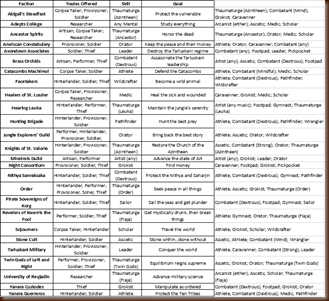
As I mentioned in the previous post, each faction has a set of affiliated skills. Members of that faction can access training in those skills more cheaply, folks hired from the faction are more likely to have the indicated skills, and advancement in the faction is contingent upon developing them.
Wednesday, October 17, 2018
Developing Factions
This post outlines how factions can serve player characters.
Characters gain different benefits depending upon their relationship with the faction in question, referred to as their Faction Status.
Unknown characters have little or no prior history with the organization. The faction is not likely to seek the characters out for work, and the character is not likely to get much out of the faction.
Known characters are recognized by local faction members. Characters gain this status after completing a significant favor for the faction or interfering in their affairs. If viewed positively, the faction is likely to seek the party out when they have need of outside help, and those viewed negatively are likely to the be the targets of harassment.
Regional Member characters are basic, run-of-the-mill members of the faction. They know and are known to all local faction members, may access faction resources and spaces (like training discounts, medical care, etc.), may hire other regional members as hirelings, and may amass faction favors. Characters who join a faction at character creation start at this status, and characters may earn this status if they are Known, in good standing with the faction, and spend 6 months being initiated (free of charge). These benefits come with some additional responsibilities: in addition to a 10% tithe of all wealth due in the month of Judgement, Regional Members are also always on-call if the faction higher-ups need a task accomplished.
Intraregional Member characters are senior members, active in two distinct areas. They have all the benefits of a Regional Member, but can access them both in their home region and one additional area of their choice. Depending on the size, organization, and goals of the faction, these regions may be defined differently. Characters are promoted to Intraregional Member status if they are a Regional Member in good standing, are Professional-tier in at least one faction skill, and spend 6 months ingratiating themselves in their new region (free of charge). While their responsibilities are the same (10% tithe and being on-call), they are able to ask for more with their favors.
Chapter Head characters dedicate considerable in-game time to the service of their faction. They gain considerable benefits but lose some character autonomy. Characters can become Chapter Heads if they are Intraregional Members in good standing, are Professional-tier in at least three faction skills, and spend 6 months at the chosen location. Chapters are usually located within cities, and the character gains a leadership position at one of the chosen city’s chapters. Characters must spend at least two months each year in residence at their chapter and pay the 10% tithe, but they are no longer on-call. In addition to being able to use their favors to greater effect, Chapter Heads may also dispatch 2d6 faction members to perform any task within the faction’s purview.
Regional Head characters are almost full-time faction employees, trading 6 months per year of faction service for authority over a large swathe of the game world. They have full authority over all faction members within their jurisdiction and can assign them at-will, as long as they keep within the mission of their faction. Regional Heads must still pay the 10% tithe. Unlike the other Faction Statuses, Regional Head positions are finite and rarely vacant. Ascending to the position will take sly political maneuvering, calling in favors at the right time, and a quest or two. This is the highest status possible for a player character.
Leaders take charge of the entire faction. This is a full-time commitment – player characters who reach this rank become NPCs.
Faction Favors
Factions operate on a quid pro quo basis – every time the characters accomplish a job for the faction, in addition to their payment they also gain a favor. Depending on the faction status of the characters, they can spend this favor in a variety of ways.
Regional Members can request up to 50gp of goods or the assistance of 1d6+1 members for 24 hours.
Intraregional Members can request up to 100gp of goods or the assistance of 2d6+2 members for 24 hours.
Chapter Heads can request up to 500gp of goods or the assistance of their entire chapter, 1d6*10 members.
Regional Heads already have full access to the faction’s coffers and may direct regional members as they wish, and thus no longer need to amass and expend favors to receive those benefits.
Additional Faction Perks
Regional Members and above may access skill training in the faction’s skills. Available instructors are typically Professional in the desired skill (3-5 ranks) and Professional Teachers. Regional centers will have Expert-tier instructors available. Because they are the faction’s teachers, students may pay the reduced rate.
Regional Members and above may also seek out faction members when looking for hirelings. Whenever a skill would be randomly determined, the player may choose a skill of the same type (Mental, Physical, or Social) from the list of faction skills, although a single skill can only be chosen once.
Tuesday, July 31, 2018
Joining a Faction
Players new to games that require a lot of logistical considerations (food tracking, encumbrance, etc.) often are overwhelmed with the responsibility of handling all of this on top of the more "normal" player responsibilities. In-game institutions can provide scaffolding for these players, providing support that diminishes as players become better at playing the game.
In Prodigy, I call these types of institutions "factions" since there are always several in an area, each vying for power. As part of character creation, players can choose a faction appropriate to their trade (class), joining that faction and gaining additional proficiency in a faction-specific skill.
| Faction | Trades Offered | Skill | Goal |
| Abigail's Steadfast | Provisioner; Soldier | Thaumaturge (Azintheen) | Protect the vulnerable |
| Adept's College | Researcher | Any Mental | Study everything |
| Areinian Constabulary | Provisioner; Soldier | Orator | Keep the peace and their money |
| Avondown Associates | Soldier; Thief | Leader | Destroy the Tarluskani regime |
| Brass Orchids | Artist; Bard; Thief | Combatant (Dextrous) | Assassinate the Tarluskani leadership |
| Catacombs Machimoi | Ognemuo, Soldier | Athlete | Defend the Catacombs |
| Facetakers | Hinterlander; Soldier; Thief | Wildcrafter | Become a wild animal |
| Hunting Brigade | Hinterlander; Provisioner; Soldier | Pathfinder | Hunt the best prey |
| Jungle Explorers' Guild | Bard; Hinterlander; Provisioner; Soldier; | Orator | Bring back the best story |
| Knights of St. Valorie | Hinterlander; Provisioner; Soldier | Thaumaturge (Azintheen) | Restore the Church of the Azintheen |
| Minstrels' Guild | Artist; Bard | Artist (any) | Advance the state of Art |
| Night Consortium | Provisioner; Soldier; Thief | Grokist | Find money |
| Nithya Jongleurs | Bard; Thief | Pickpocket | Stun the crowd. Leave town |
| Nithya Sanraksaka | Hinterlander; Soldier; Thief | Combatant (Dextrous) |
Protect the Nithya
and
Saharjin
|
| Order of St. Lussier | Provisioner; Researcher | Chemist | Heal the sick and wounded |
| Pirate Sovereigns of Korg | Hinterlander; Soldier; Thief | Sailor | Sail the seas and get plunder |
| Revelers of Kwerris the Fool | Bard; Soldier; Thief | Thaumaturge (Fiaja) | Get mystically drunk, then break things |
| Sojourners | Hinterlander | Scholar | Travel the world |
| Tarluskani Military | Hinterlander; Provisioner; Soldier | Leader | Conquer the world |
| University of Reyjadin | Researcher | Thaumaturge (Fiaja) | Advance military science |
| Yanera Custodes | Thief | Grokist | Manipulate as ordered |
| Yanera Guerreros | Hinterlander; Soldier | Athlete | Protect the Ten Tribes |
Faction membership is only limited by geography (most factions exist only in specific areas of the world), culture (some factions only admit members from their associated culture) and trade.
To spell out the obvious, factions provide a number of built-in services for characters: they offer employment, training, lodging and food, and (perhaps most importantly) a default goal. As I've run games, I've noticed that my players are often hesitant to define their own goals, to set their own agenda. I've found that offering some vague direction, like the goals listed above, helps players develop their agency. Having multiple characters from the same faction provides an initial consensus that helps players get moving.
The above is not new or revolutionary information. Moving forward on this, I want to further develop how players can join factions after character creation as well as better outline how a faction's presence in an area manifests - how many personnel, distributed how, pursuing what goals.
Saturday, July 16, 2016
The Brass Orchids
First, some background information. Before the Tarluskani invaded and founded the Tarluskani Empire, the Confederacy was home to 30 feuding city-states. The region was resource-abundance and the wars were petty affairs, so life in the cities was very stable. Because of the stability and prosperity of the area, urban folks had the time and resources to support the arts - architecture, ceramics, cooking, drawing, literature, music, performing arts, sculpture, and swordplay, and artists would often compete to bring pride to their home city-state.
When the Tarluskani invaded, they banned representational art and enslaved the entire population. However, the artistic class still existed, just driven underground. Using their art to embolden the spirit of the enslaved Confederates and strike back against their Tarluskani oppressors, the Brass Orchids (name stolen from Delaney's Dhalgren) were founded as an artistic resistance movement, creating massive murals overnight and sneaking instruments and figurines into slave pens all over the Confederacy. Just creating art would not be enough, they knew, and so the duelists became assassins, striking down Tarluskani who abused their slaves and high-ranking military targets.
The faction is essentially a decentralized terrorist organization that sees itself as the defenders of an indigenous way of life uprooted by the Tarluskani some 80 years ago. The bulk of the enslaved populace have acclimated to their slavery and while some see the Brass Orchids as young firebrands who mean well but only bring trouble down upon the very people they claim to protect, most see them as a threat more dangerous than their predictable Tarluskani masters. More than anything else, the Brass Orchids are an ideology to which any can claim adherence.
They have vibes of the student's rebellion as expressed in Les Miserables with tinges of Modernist art - in other words, they are an organization entirely at odds with the early-Renaissance aesthetic of the rest of my world (along with the other terrorist organization, the Avondown Associates). However, despite the anachronism, it is important to keep them.
The Avondown Associates are a group of Southerners, mostly former thieves, who are attempting to oust the Tarluskani from their city, now renamed Reyjadin. When I first introduced my players to the world of Prodigy, I gave my party good reason to join them. The slow realization that the party had aided and abetted racially-motivated terrorism (since the Southerners and Tarluskani are different ethnicities) made them incredibly uncomfortable, and it is important that my world be able to put players into that kind of position and force them to grapple with this issue, especially today, when terrorism has become a part of the Western consciousness.
Alexis recently wrote about the Senegalese slave trade and addressed placing the cruel realities often found in the real world within the game one. I agree with him. One of the central themes of the world of Prodigy is cultural intersection, which happens both positively and negatively. It presents (and creates) gross injustices that a civic-minded party has to grapple with, and I've tried to give every culture, every faction, both a positive and a negative aspect. The Brass Orchids are freedom fighters seeking a better world for the Confederates and are the only 'organization' in the world of Prodigy that sees art as more than mere entertainment (and would be able to take advantage of the work on bards I'm doing right now). They can also be cruel and callous killers, willing to let the repercussions of their actions fall upon their people for the 'greater good'. The party gets to decide whether the one balances the other, or not.