Thursday, March 19, 2020
Petwia's House of Refuge
As Petwia is Jewish, the Catholic Church, which normally underwrites such enterprises, won't provide any aid, so the fiscal support needs to come from Petwia, summing to 8gp a month. This money covers food and upkeep costs for the boarders and caregivers.
As this 8gp a month goes towards tikkun olam, Petwia will receive 160xp each month (the value of the donation in silver pieces).
Thursday, July 4, 2019
Tarot Crawling
I've written about bells before. As a quick recap, bells ward off bad things (thieves, storms, spirits, witches, bad luck, demons, etc.), but it is difficult to model that at the table unless these warded-against forces actually plague the characters. And I'm not interested in making my players' lives more stressful in their urban interactions. However, by assigning 'bad luck' types of events to Tarot cards, which I present in the zine as an alternative to random(ish) encounters, I find a use for bells.
Bells make traveling more safe by reducing the chances of bad things happening. Different modalities and melodies ward off different things, and better bellringers can choose to weave together these modalities and melodies to abjure against more things at once. At the table, the player chooses some number of cards to avoid from a pre-selected list (boginky, spirits, delaying circumstances, catastrophe, traveling accident, and a few others). If I would reveal that card while the characters travel, I instead shuffle it back into the deck. If I draw that card again, the bells have no effect.
Silver bells repel boginky, both the card that invokes them and, if encountered anyways, will keep them at bay as long as the bells sound.
Friday, June 14, 2019
A New Beginning
About two weeks ago, I shuttered development on the Sea of Shadows. Questions of cultural appropriation had hounded me from the beginning, but seeing JB's new project, I realized that 1) the Sea of Shadows was, no matter my care and attention to detail, an appropriative project and 2) there are some phenomenal designers already working on places and spaces like what I wanted the Sea of Shadows to be (Zedeck Siew's and Munkao's http://athousandthousandislands.com/ is an excellent example). I felt an ethical need to refocus my (colonizing) attention away from the Sea of Shadows. I'd love to return there with other, better qualified designers, but that is a dream for another time.
Instead, I have started work on a new region within the same world: Gelgelim, from the Hebrew word for wheels. As a Jew and a Pole, there is a vast treasury of Slavic, Ashkenazi, and Polish folklore that is weird and interesting and worth exploring. My players agreed to take the plunge with me and we created new characters and begun a new game within Gelgelim a couple of weeks ago.
The following is the description of the setting as it appears in the Core Book. I'll have posts on bears, birds, boginky, bells, and kabbala coming out in the next week or so (I'm on a half-vacation with WiFi, so I've the time to bang all of this out).
“Gelgelim channels Polish, Slavic, and Ashkenazi lifeways with a dollop of Irish and Welsh folklore into an area some 360,000 square miles large (about the size of Germany or Japan). To the north lie the toxic ruins of the Azintheen Empire, filled with bronze monstrosities and powerful magics. The rugged lands to the west resist exploration. And Chornilis, the black woods, blocks southward and eastward travel.
“The time is a century after the Scorching, a man-made cataclysm that destroyed the Azintheen Empire, boiling the land and souring the sea. In Gelgelim, the forest responded to the Scorching by expanding hundreds of hectares in a single day, consuming towns and cities and blocking passage east. The remaining towns and villages of Gelgelim have yet to fully recover. Toxic ashfalls and contaminated water have claimed many a would-be explorer, and the bears roaming wild have claimed many more.
“For money, fame, power, or the good of your village, you have decided to brave these dangers and explore the wilds. Good luck.”
Monday, May 6, 2019
Pamphlet Up and Other News
Itch.io's most significant feature, however, is the game jam. Anyone with an account can host a jam, which is an open submission forum for games dealing with some topic decided by the jam's creator. Some of these topics are thematic, some are structural. The game jam allows you to find and follow other creators who do similar work and to give your submitted work some publicity. Itch.io handles payment if you want to charge for your material. My account page has my first 'published' product, a free-to-download pamphlet describing a sequence of 7 nights by a crossroad. I'd love feedback, if you wanted to give it a read. Itch.io gives me a place to publish material that won't see the light of day in my regular game for a while (we had a TPK last session and are starting a new game in a different region, so much of my private brainstorming on the Stone Cult won't be immediately useful). I can build a body of work outside these blog posts with the Stone Cult and practice some skills that need honing (like dungeon design).
In other news, I've changed the name of my game from Prodigy to Saharjin. Ultimately, this is because there is another roleplaying game called Prodigy on the market, and although our games are completely different, I took this as an opportunity to find a name that speaks more to what my game is about: Saharjin is the name of the magical rainforest that dominates much of my setting.
Thanks for sticking with me. Now that I've my ADHD medication and it's turning into summer, I'm looking forward to being more active and posting more content.
Friday, April 12, 2019
Cultural Capitals
Thursday, April 11, 2019
Prodigy Character Creation Rules
Tuesday, March 26, 2019
An Addendum for Character Creation
It struck me recently that I could use tarot cards to accomplish a similar result, with some added interpretive benefits. I present the following set of rules as an add-on to the character creation process. They flesh out a character’s personal relationships and history with enough vagueness for the Facilitator and players to come to a mutual understanding about the impacts of this history on the game. The cards identify 5-6 individuals important to the character. For games that avoid inter-player conflicts like Prodigy and most D&D-adjacent games, I recommend allowing different characters to have NPCs in common but have another person’s character as one of these 5-6 individuals. For more storytelling-focused games, do what you will.
The mechanical implications of this are simple. Each character has a heart card that typifies them. Whenever that heart card appears in a card mechanic later in the game, it means that the character has a personal stake in the events transpiring. If the heart card appears in the player’s hand, this personal connection works in their favor and grants a benefit. If it is played against them, the character immediately loses or takes some penalty.
The Deck: one tarot deck (78 cards)
Shuffle the deck and have the player draw 1 card at a time. One character can be generated at a time from one deck (shuffle between readings).
The first card is the Heart card. This determines how others perceive your character at first glance. It also determines the character’s birth month. I use 13 lunar cycles in my world and have assigned them accordingly. Each lunar cycle shares the first letter with the solar month it resembles, with Equivocation as the 13th month (the change between wet and dry seasons happens halfway through Equivocation).
We next lay out a 5x3 grid:
We sum each row to get our attributes. Most Tarot cards have a number (aces are 1). Court cards are assigned a value based upon their station: Page is 1, Knight is 2, Queen is 4, and King is 8. We convert these sums to attributes as following:
From this point forward, we interpret the cards to infer a character’s personal background. This reading is performed as the character reaches adulthood, before they choose a trade. It does not force a character down a certain path, but players should feel free to let the cards suggest a profession.
Cards 3, 8, 13 represent the character’s past, present, and goals, respectively.
Cards 1, 6, and 11 reflect the character’s social circle, their kin (chosen family or biological relationships). The first card describes this network overall. The second corresponds to the character’s connection with the social circle. Card 11 indicates the person in this social circle with which the character is closest.
Cards 2, 7, and 12 further explore the social circle. Card 2 personifies the leader of the group. Card 7 reflects the group’s emotional core, and card 12 typifies a member of the group lurking on the group’s fringes.
The social circle has at least 3 members (as card 11 might correspond to cards 2, 7, or 12). Its full size is equal to the number of adjacent pairs of cards in the spread of the same suit (major arcana acts as its own suit). Adjacency works along a grid axis, so no diagonals.
Cards 4, 9, and 14 correspond to a mentor or guiding figure, someone who has had a large impact on the character but remains distant. Card 4 describes this person as they relate to the character, while card 9 indicates their occupation. Card 14 details this figure’s current status – their goals and life circumstances.
Cards 5, 10, and 15 encompass a long-standing and significant relationship. Card 5 describes a formative shared experience that bonded the character to this person. Card 10 explicates the current relationship between the character and this person, while card 15 indicates this person’s current goals.
Friday, January 18, 2019
Chases and Pursuits
In a pursuit there are two major events that must occur for the escapee to successfully elude their pursuers: they must break line of sight and then avoid the ensuing search. In order to break line of sight, the leads (those fleeing) must gain enough distance from their follows (those chasing) in order to break line of sight and then maintain it. If one ducks behind a corner and, mere milliseconds later, the follow ducks behind that same corner, it is unlikely the maneuver gained the lead anything. Given several seconds, however, the leads' chances increase dramatically.
As I usually do before making new rules, I scoured the internet to see what other folks had suggested. Unfortunately, almost every set of chase or pursuit rules I found were modelled after action cinema chases, which are less a pursuit and more a fight sequence that takes place while traversing difficult terrain, and I consequently needed to reframe much of what I found. The following rule still requires a fair amount of complication (having rules for multiple groups herding or hounding a lead, longer-duration chases, etc.) but should cover my bases for now.
There are 6 positions in a chase. Rather than tracking exact yards covered, I care about approximate ranges, using the number 6 for convenience.
1: Follows catch up to leads
2: Hot on Their Heels
3: In Pursuit
4: In Pursuit
5: In Pursuit
6: Follows have lost the leads
We determine the initial distance between leads and follows via card draw. A diamond is position 2, heart is position 3, club is position 4, and spade is position 5.
We track the chase on a minute-by-minute basis, which incorporates my rules on how long characters may sprint: their Strength modifier minus 3 equals the number of minutes they may run. Every minute spent running thereafter requires a Constitution test of increasing difficulty starting at Apprentice. Unusually for a pursuit, characters who fail this test may take damage equal to the difference between their result and the difficulty to continue running.
At the beginning of each minute, we determine how the characters are grouped. Characters of equal AP in the same position form a single cluster. Each cluster draws 1 card per AP and may draw more if all cluster members take 1 damage per additional card.
Follow clusters compare their cards to the nearest lead cluster. If they are able to cancel out the lead cluster's cards, they advance by 1 position. If not, the follow falls behind by 1 position. To make this somewhat easier, we allow clusters to manipulate their cards.
Diamonds are a trump suit, meaning that a diamond beats any other non-diamond, regardless of numerical card value, and that only a higher diamond beats a diamond card. The Ace of Diamonds cannot be bested.
Clubs can become diamonds via a successful Constitution test.
Spades can become diamonds via a successful Gymnast test.
Hearts can become diamonds via a successful Understanding test.
The difficulty for these tests depends upon the numerical value of the card. 2-6 is Apprentice, 7-10 and J are Professional, Q and K are Expert, and Aces require a Master-difficulty test.
However, follow clusters who are 'Hot on Their Heels' may not adjust their cards - they must be lucky to finally overtake the leads.
Wednesday, October 17, 2018
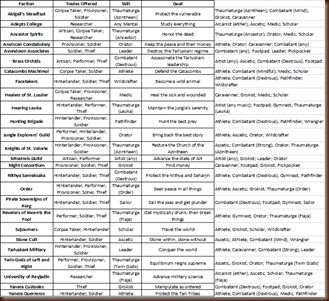
Faction Skills
Developing Factions
This post outlines how factions can serve player characters.
Characters gain different benefits depending upon their relationship with the faction in question, referred to as their Faction Status.
Unknown characters have little or no prior history with the organization. The faction is not likely to seek the characters out for work, and the character is not likely to get much out of the faction.
Known characters are recognized by local faction members. Characters gain this status after completing a significant favor for the faction or interfering in their affairs. If viewed positively, the faction is likely to seek the party out when they have need of outside help, and those viewed negatively are likely to the be the targets of harassment.
Regional Member characters are basic, run-of-the-mill members of the faction. They know and are known to all local faction members, may access faction resources and spaces (like training discounts, medical care, etc.), may hire other regional members as hirelings, and may amass faction favors. Characters who join a faction at character creation start at this status, and characters may earn this status if they are Known, in good standing with the faction, and spend 6 months being initiated (free of charge). These benefits come with some additional responsibilities: in addition to a 10% tithe of all wealth due in the month of Judgement, Regional Members are also always on-call if the faction higher-ups need a task accomplished.
Intraregional Member characters are senior members, active in two distinct areas. They have all the benefits of a Regional Member, but can access them both in their home region and one additional area of their choice. Depending on the size, organization, and goals of the faction, these regions may be defined differently. Characters are promoted to Intraregional Member status if they are a Regional Member in good standing, are Professional-tier in at least one faction skill, and spend 6 months ingratiating themselves in their new region (free of charge). While their responsibilities are the same (10% tithe and being on-call), they are able to ask for more with their favors.
Chapter Head characters dedicate considerable in-game time to the service of their faction. They gain considerable benefits but lose some character autonomy. Characters can become Chapter Heads if they are Intraregional Members in good standing, are Professional-tier in at least three faction skills, and spend 6 months at the chosen location. Chapters are usually located within cities, and the character gains a leadership position at one of the chosen city’s chapters. Characters must spend at least two months each year in residence at their chapter and pay the 10% tithe, but they are no longer on-call. In addition to being able to use their favors to greater effect, Chapter Heads may also dispatch 2d6 faction members to perform any task within the faction’s purview.
Regional Head characters are almost full-time faction employees, trading 6 months per year of faction service for authority over a large swathe of the game world. They have full authority over all faction members within their jurisdiction and can assign them at-will, as long as they keep within the mission of their faction. Regional Heads must still pay the 10% tithe. Unlike the other Faction Statuses, Regional Head positions are finite and rarely vacant. Ascending to the position will take sly political maneuvering, calling in favors at the right time, and a quest or two. This is the highest status possible for a player character.
Leaders take charge of the entire faction. This is a full-time commitment – player characters who reach this rank become NPCs.
Faction Favors
Factions operate on a quid pro quo basis – every time the characters accomplish a job for the faction, in addition to their payment they also gain a favor. Depending on the faction status of the characters, they can spend this favor in a variety of ways.
Regional Members can request up to 50gp of goods or the assistance of 1d6+1 members for 24 hours.
Intraregional Members can request up to 100gp of goods or the assistance of 2d6+2 members for 24 hours.
Chapter Heads can request up to 500gp of goods or the assistance of their entire chapter, 1d6*10 members.
Regional Heads already have full access to the faction’s coffers and may direct regional members as they wish, and thus no longer need to amass and expend favors to receive those benefits.
Additional Faction Perks
Regional Members and above may access skill training in the faction’s skills. Available instructors are typically Professional in the desired skill (3-5 ranks) and Professional Teachers. Regional centers will have Expert-tier instructors available. Because they are the faction’s teachers, students may pay the reduced rate.
Regional Members and above may also seek out faction members when looking for hirelings. Whenever a skill would be randomly determined, the player may choose a skill of the same type (Mental, Physical, or Social) from the list of faction skills, although a single skill can only be chosen once.
Saturday, September 8, 2018
The Tarluskani Empire
The Islands of Korg
The Khanates
Sunday, September 2, 2018
Expanding the Card Mechanic
| Caravanner | Mechanist | Persuasion | Ritual Mishaps | Wildcrafter | Wrangler | |
| Hearts | Social | Jam | Bitterness | Changed | Tainted food | Defiant |
| Ace | 4 ranks principle | Lock sealed | New enemy | roll 2d4+2d6 | Half inedible | Cannot be trained |
| King | 3 ranks principle | 4 people to unstick | Followers, hirelings accosted | roll 2d4+1d6 | Third inedible | 4x time to retry |
| Queen | 2 ranks principle | 3 people to unstick | Party waylaid | roll 1d4+1d6 | Quarter inedible | 3x time to retry |
| Jack | 1 rank principle | 2 people to unstick | Reputation tarnished | roll 1d6 | Quarter inedible | 2x time to retry |
| Diamonds | Add card | Break pick | Bribery | Greedy | Misidentified | As hearts |
| Ace | ranks +2 | Break 4 | Bribe as 14 | 4x | All weeds | Unbroken |
| King | ranks +1 | Break 3 | Bribe as 13 | 3x | 75% weeds | 4x time |
| Queen | ranks +1 | Break 2 | Bribe as 12 | 3x | 50% weeds | 3x time |
| Jack | ranks +1 | Break 2 | Bribe as 11 | 2x | 50% weeds | 2x time |
| Clubs | Physical | Noise | Violence | Drained | Broken gear | Feral |
| Ace | 4 ranks principle | 6d6 yards | All-out assault | 1 injury | 8 pieces | Eats people |
| King | 3 ranks principle | 6d4 yards | Kidnapping | Take 3 damage | 6 pieces | Attacks people |
| Queen | 2 ranks principle | 4d6 yards | New faction involved | Take 2 damage | 4 pieces | Afraid of people |
| Jack | 1 rank principle | 4d4 yards | Lodgings assaulted | Take 2 damage | 2 pieces | Retry +1 cards |
| Spades | Mental | Slowed | Negation | Flawed | Infected | As clubs |
| Ace | 4 ranks principle | Quadruple time spent | Negate and duplicate | Higher tier ritual | Take 1 injury | Eats people |
| King | 3 ranks principle | Triple time spent | Negates 3 | All random | Take 3 damage | Attacks people |
| Queen | 2 ranks principle | Double time spent | Negates 2 | Random ritual | Take 2 damage | Afraid of people |
| Jack | 1 rank principle | Double time spent | Negates 2 | Random focus | Take 1 damage | Retry +1 cards |
Wednesday, August 8, 2018
Monster Descriptions 4-9
Thursday, August 2, 2018
Home Ownership
This does invite a new and interesting question. Given my framework of blocks and neighborhoods, how do I make rules for owning and managing a household?
The first thing I want to address is how the neighborhood affects the price of the house. The number in my price list is for the construction itself, not fitting it into an existing urban space. It seems reasonable to multiply the house price by the number of blocks within a given neighborhood, a reflection of how scarce space is within the area. Furthermore, not all types of buildings are available in all neighborhoods.
Now, to make this choice more interesting, what advantages does owning a home in a neighborhood provide? There is first an important distinction between having a home in a neighborhood versus having a home in a specific block. Each block is a space made up of not only streets and buildings but also of people, people who have known each other a long time. Adventurers are not likely to become members of a block, but their home's nearness to them should confer some sort of mechanical benefit.
Establishing a home requires more than simply purchasing a building. After moving in, the inhabitants must spend a week meeting and greeting their neighbors to unlock the benefits of their chosen location. This involves a lot of eating and drinking and costs double the daily rate. If the party waits more than a month after purchasing the home, the neighbors' first impression is negative and the benefits will be lost.
Assuming the players spend the week, they may access all blocks within their neighborhood at half-price. This benefit lasts a full year. By spending a month socializing (spending double the daily rate), this benefit can be renewed and extended another full year. This benefit is conferred per character, not per household - each principal character (excluding hirelings, followers, and henchfolk) must either directly participate in the socializing or have one of their henchfolk represent them.
In the city, it is customary to have two people tending the house. This ensures that someone is always present in the building even if errands must be run. The two will ensure that food is purchased and ready to eat when the house's other inhabitants return.
This will do for now, but I'll return to this in the future with rules describing how decorating the house can provide benefits for those who live there.
Paying per Day
Monster Descriptions 2 and 3
The burrow descends into the hillside, just large enough to crawl inside. Upon entering the dark, a menacing croak rumbles through the passage, and two yellow eyes stare balefully out.
The clearing is pitted with large holes, wide enough to swallow someone hole, but what commands attention is the great worm stretching out of one, whistling out of its circular maw. Its red skin glistens with some sort of fluid, a fluid that lingers at the edge of each hole.
Persuasion Examples
Our initial encounter is fairly straightforward: the party has been caught wandering the city after curfew. There are 4 watchmen and 6 party members. The watchmen are Novice Ascetics while the best Orator in the party is Apprentice.
The watchmen draw a Jack of spades but, because they have no ranks in Ascetic, draw a replacement card: the King of diamonds. I keep drawing until we get a number card: the 9 of diamonds. Even though the Orator is a Novice Grokist, I still play this card faceup. I shuffle the deck before the players draw. The player draws 2 cards, the Queen of diamonds and the 9 of clubs.
The player chooses the Queen, and the players succeed - they pay the requisite amount (the daily wage) and may be about their business. If they for some reason chose the 9 of clubs, they would fail and must pay 512 * the daily wage (this is less terrible than it might sound: in the players' current city, Tal Afar, the wage is 8 bronze pieces, making the required bribe equal to 17 gold pieces). If the players cannot or will not pay, the watchmen in question will hound the party for the next 9 days. Regardless of whether they pay or not, the watchmen insist the party return indoors (and will fight if the party refuses).
As a second example, a new party wishes to access the University of Reyjadin's archive on ritual magic. The attending archivist is a grumpy old woman who has no time for dirty adventurer types. She is a Professional Ascetic, while the party's best Orator is but Apprentice. Because the player cannot play enough cards, the attempt ends immediately, with no consequences for the party (although, consequences will certainly follow trying to access the archive anyway).
If the party then spends some time developing their rhetorical skills and return once their Orator is a Specialist, we draw cards. The party's Orator is an Apprentice Grokist, which reveals the first two of the archivist's cards. I draw faceup the 10 of spades and the 10 of hearts, and then draw facedown the 5 of spades. The first card, the 10 of spades, determines the trump (spades).
The player then draws their four cards: the 9 of diamonds, 6 of hearts, 10 of clubs, and King of clubs. They may only use 3 of their 4 cards directly against the archivist and must choose their 3 before the archivist's final card is revealed. They choose both clubs and the 6 of hearts, since it matches suit with one of the faceup cards. The 9 is removed - it can be used to modify the played cards, but can't directly attack one of the archivist's cards.
I reveal the archivist's final card, the 5 of spades, and the player now must decide how to allocate their cards. They can't beat all of the archivist's cards and are now trying to mitigate the damage from failing. Because each undefeated spade will remove one of their cards, they can't avoid the penalty from the 10 of hearts. Consequently, the players are stuck outside of the archive until the archivist cools down (10 days later).
For a third and final example, our now-Specialist Orator encounters the same watch patrol as before. The watch draws an 8 of diamonds, played faceup, while the player draws 4 cards: the 7 of hearts, Joker, ace of spades, and King of spades. The player chooses the 7 of hearts to oppose the watch's card. They discard a card to transform their heart into a diamond, and, because the card is now a diamond, they spend double the daily rate to increase the 7 to an 8, which defeats the watchmen's card. The players pay the watchmen 18 bronze pieces and go about their way.