

We had a chase in my game last Monday and I realized that what rules I had for pursuits were not sufficient. I've hopefully now rectified the problem.
In a pursuit there are two major events that must occur for the escapee to successfully elude their pursuers: they must break line of sight and then avoid the ensuing search. In order to break line of sight, the leads (those fleeing) must gain enough distance from their follows (those chasing) in order to break line of sight and then maintain it. If one ducks behind a corner and, mere milliseconds later, the follow ducks behind that same corner, it is unlikely the maneuver gained the lead anything. Given several seconds, however, the leads' chances increase dramatically.
As I usually do before making new rules, I scoured the internet to see what other folks had suggested. Unfortunately, almost every set of chase or pursuit rules I found were modelled after action cinema chases, which are less a pursuit and more a fight sequence that takes place while traversing difficult terrain, and I consequently needed to reframe much of what I found. The following rule still requires a fair amount of complication (having rules for multiple groups herding or hounding a lead, longer-duration chases, etc.) but should cover my bases for now.
There are 6 positions in a chase. Rather than tracking exact yards covered, I care about approximate ranges, using the number 6 for convenience.
1: Follows catch up to leads
2: Hot on Their Heels
3: In Pursuit
4: In Pursuit
5: In Pursuit
6: Follows have lost the leads
We determine the initial distance between leads and follows via card draw. A diamond is position 2, heart is position 3, club is position 4, and spade is position 5.
We track the chase on a minute-by-minute basis, which incorporates my rules on how long characters may sprint: their Strength modifier minus 3 equals the number of minutes they may run. Every minute spent running thereafter requires a Constitution test of increasing difficulty starting at Apprentice. Unusually for a pursuit, characters who fail this test may take damage equal to the difference between their result and the difficulty to continue running.
At the beginning of each minute, we determine how the characters are grouped. Characters of equal AP in the same position form a single cluster. Each cluster draws 1 card per AP and may draw more if all cluster members take 1 damage per additional card.
Follow clusters compare their cards to the nearest lead cluster. If they are able to cancel out the lead cluster's cards, they advance by 1 position. If not, the follow falls behind by 1 position. To make this somewhat easier, we allow clusters to manipulate their cards.
Diamonds are a trump suit, meaning that a diamond beats any other non-diamond, regardless of numerical card value, and that only a higher diamond beats a diamond card. The Ace of Diamonds cannot be bested.
Clubs can become diamonds via a successful Constitution test.
Spades can become diamonds via a successful Gymnast test.
Hearts can become diamonds via a successful Understanding test.
The difficulty for these tests depends upon the numerical value of the card. 2-6 is Apprentice, 7-10 and J are Professional, Q and K are Expert, and Aces require a Master-difficulty test.
However, follow clusters who are 'Hot on Their Heels' may not adjust their cards - they must be lucky to finally overtake the leads.
Subscribe!

 Posts
All Comments
Posts
All Comments
Friday, January 18, 2019

Wednesday, October 17, 2018
Faction Skills
As I mentioned in the previous post, each faction has a set of affiliated skills. Members of that faction can access training in those skills more cheaply, folks hired from the faction are more likely to have the indicated skills, and advancement in the faction is contingent upon developing them.
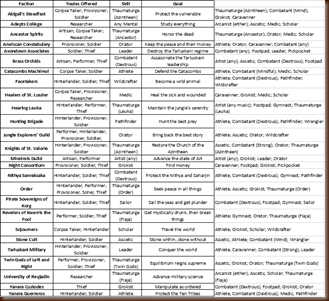
Developing Factions
This post outlines how factions can serve player characters.
Characters gain different benefits depending upon their relationship with the faction in question, referred to as their Faction Status.
Unknown characters have little or no prior history with the organization. The faction is not likely to seek the characters out for work, and the character is not likely to get much out of the faction.
Known characters are recognized by local faction members. Characters gain this status after completing a significant favor for the faction or interfering in their affairs. If viewed positively, the faction is likely to seek the party out when they have need of outside help, and those viewed negatively are likely to the be the targets of harassment.
Regional Member characters are basic, run-of-the-mill members of the faction. They know and are known to all local faction members, may access faction resources and spaces (like training discounts, medical care, etc.), may hire other regional members as hirelings, and may amass faction favors. Characters who join a faction at character creation start at this status, and characters may earn this status if they are Known, in good standing with the faction, and spend 6 months being initiated (free of charge). These benefits come with some additional responsibilities: in addition to a 10% tithe of all wealth due in the month of Judgement, Regional Members are also always on-call if the faction higher-ups need a task accomplished.
Intraregional Member characters are senior members, active in two distinct areas. They have all the benefits of a Regional Member, but can access them both in their home region and one additional area of their choice. Depending on the size, organization, and goals of the faction, these regions may be defined differently. Characters are promoted to Intraregional Member status if they are a Regional Member in good standing, are Professional-tier in at least one faction skill, and spend 6 months ingratiating themselves in their new region (free of charge). While their responsibilities are the same (10% tithe and being on-call), they are able to ask for more with their favors.
Chapter Head characters dedicate considerable in-game time to the service of their faction. They gain considerable benefits but lose some character autonomy. Characters can become Chapter Heads if they are Intraregional Members in good standing, are Professional-tier in at least three faction skills, and spend 6 months at the chosen location. Chapters are usually located within cities, and the character gains a leadership position at one of the chosen city’s chapters. Characters must spend at least two months each year in residence at their chapter and pay the 10% tithe, but they are no longer on-call. In addition to being able to use their favors to greater effect, Chapter Heads may also dispatch 2d6 faction members to perform any task within the faction’s purview.
Regional Head characters are almost full-time faction employees, trading 6 months per year of faction service for authority over a large swathe of the game world. They have full authority over all faction members within their jurisdiction and can assign them at-will, as long as they keep within the mission of their faction. Regional Heads must still pay the 10% tithe. Unlike the other Faction Statuses, Regional Head positions are finite and rarely vacant. Ascending to the position will take sly political maneuvering, calling in favors at the right time, and a quest or two. This is the highest status possible for a player character.
Leaders take charge of the entire faction. This is a full-time commitment – player characters who reach this rank become NPCs.
Faction Favors
Factions operate on a quid pro quo basis – every time the characters accomplish a job for the faction, in addition to their payment they also gain a favor. Depending on the faction status of the characters, they can spend this favor in a variety of ways.
Regional Members can request up to 50gp of goods or the assistance of 1d6+1 members for 24 hours.
Intraregional Members can request up to 100gp of goods or the assistance of 2d6+2 members for 24 hours.
Chapter Heads can request up to 500gp of goods or the assistance of their entire chapter, 1d6*10 members.
Regional Heads already have full access to the faction’s coffers and may direct regional members as they wish, and thus no longer need to amass and expend favors to receive those benefits.
Additional Faction Perks
Regional Members and above may access skill training in the faction’s skills. Available instructors are typically Professional in the desired skill (3-5 ranks) and Professional Teachers. Regional centers will have Expert-tier instructors available. Because they are the faction’s teachers, students may pay the reduced rate.
Regional Members and above may also seek out faction members when looking for hirelings. Whenever a skill would be randomly determined, the player may choose a skill of the same type (Mental, Physical, or Social) from the list of faction skills, although a single skill can only be chosen once.
Saturday, September 8, 2018
The Tarluskani Empire
Half a century after the Scorching, a man named Isram united the
Tarluskani tribes dwelling in the desert north of the Khanates. He named
himself Warlord Isram and directed his horde southward, conquering the
city-states and enslaving the populace.
After the Khanite
subjugation, Isram transitioned to Reyja, declaring her rule the first of the
Tarluskani Empire. She gave the tribes of her most trusted supporters command
over a city each before marching her forces south through Saharjin to invade Deliverance.
She perished in the siege of Avondown, Deliverance’s final stronghold, and her
wife’s ward, Arbab, took command of the Empire. They renamed Avondown ‘Reyjadin’
in Reyja’s honor and distributed command of the newly-conquered provinces over
to their most trusted generals before returning to the Empire’s capital, Tarlusya.
The Empire
resembles a constellation of loosely-aligned districts, each governed by a single
tribe. While all pay fealty to Emperor Rajj, the tribes frequently squabble
with each other when unsupervised. Each tribe has a specific glyph marking their
flags, armor, and official seals.
A Tarluskani’s
tribal heritage is central to their identity. It determines their allies, their
enemies, and their sacred stories. Acting honorably is crucial; their behavior
reflects on how others will view their tribe. Disputing a Tarluskani’s honor
can only be resolved with a swift apology or a duel to the death. Disrespecting
an entire tribe usually leads to a far more unpleasant fate.
While most in
Deliverance avoided slavery, almost all in the former Khanite city-states are
still enslaved. Non-ethnic Tarluskani, both slaves and freefolk, can join a
tribe through a decade of military service to the Empire.
The Islands of Korg
The islands of Korg stand between the Sea of Shadows and
the wide ocean beyond. When the Tarluskani invaded the Azure Sultanate, the
surviving Khanite bureaucrats and merchants fled to Korg. There, they established
an independent principality, sustained through piracy. These immigrants became
the Pirate Sovereigns of Tal Afar. While they initially preyed only on
Tarluskani vessels, their principles have eroded with time.
The Pirate
Sovereigns keep to themselves, playing intrigues against one another and
plotting the next big adventure, leaving the ordinary folks in Korg free to do
whatever they please. Consequently, no one in Korg cares what or how someone
fucks, provided they do not make a mess. As emotional attachments provide an
obvious vulnerability, those in committed relationships (queer or otherwise) work
to keep them quiet.
As the
center for piracy, Korg caters to a rough crowd. While many children are born
in Korg, few survive to adulthood. Those that do were often nourished on the
tall and not-so-tall tales traded among the more seasoned pirates.
The Khanates
As a reference for my players, I'm posting publicly some general overview information about each of the large regions they currently know about.
North of Saharjin, but south of the northern
desert lies a constellation of city-states known as the Khanates. While
currently the seat of the Tarluskani Empire, before the Scorching these cities
were part of the Azure Sultanate. A Khan ruled each city-state, advised by an
army of ministers. Constantly feuding, each city vied for influence with both
the Azure Sultan and the mystic Threnna
peoples from Saharjin. The Tarluskani took advantage of the Scorching’s
devastation and quickly overran the city-states, enslaving all their citizens.
All Khanites are branded,
usually on their forehead or cheek. Slaves have three choices: toil in slavery
until death, enlist in the Tarluskani military to be freed after ten years, or
escape and flee slave-catchers forever. Escaped or freed slaves often hide
their tattoo with scarring or a new tattoo.
Most Khanites have adopted the
customs and dress of the Tarluskani and study the Myths of Fiája. Consequently,
little remains of the culture of the Azure Sultanate. Some activists work to revive
the practices of the Azure Sultanate, but the Tarluskani government takes a dim
view of such efforts.
Sunday, September 2, 2018
Expanding the Card Mechanic
After teaching my players the Persuasion rules and having them come up several times during the running, I'm pleased to say they worked exactly how I wanted them to, with a few adjustments.
During our discussion after the fact about the new mechanic, one of my players suggested I find other uses for it, other skills that's resolution could best be determined through this card process. We brainstormed a list, and I've now a table that lists each skill and the unique failure conditions for each suite and face card (except for Artist, which will need its own table).
| Caravanner | Mechanist | Persuasion | Ritual Mishaps | Wildcrafter | Wrangler | |
| Hearts | Social | Jam | Bitterness | Changed | Tainted food | Defiant |
| Ace | 4 ranks principle | Lock sealed | New enemy | roll 2d4+2d6 | Half inedible | Cannot be trained |
| King | 3 ranks principle | 4 people to unstick | Followers, hirelings accosted | roll 2d4+1d6 | Third inedible | 4x time to retry |
| Queen | 2 ranks principle | 3 people to unstick | Party waylaid | roll 1d4+1d6 | Quarter inedible | 3x time to retry |
| Jack | 1 rank principle | 2 people to unstick | Reputation tarnished | roll 1d6 | Quarter inedible | 2x time to retry |
| Diamonds | Add card | Break pick | Bribery | Greedy | Misidentified | As hearts |
| Ace | ranks +2 | Break 4 | Bribe as 14 | 4x | All weeds | Unbroken |
| King | ranks +1 | Break 3 | Bribe as 13 | 3x | 75% weeds | 4x time |
| Queen | ranks +1 | Break 2 | Bribe as 12 | 3x | 50% weeds | 3x time |
| Jack | ranks +1 | Break 2 | Bribe as 11 | 2x | 50% weeds | 2x time |
| Clubs | Physical | Noise | Violence | Drained | Broken gear | Feral |
| Ace | 4 ranks principle | 6d6 yards | All-out assault | 1 injury | 8 pieces | Eats people |
| King | 3 ranks principle | 6d4 yards | Kidnapping | Take 3 damage | 6 pieces | Attacks people |
| Queen | 2 ranks principle | 4d6 yards | New faction involved | Take 2 damage | 4 pieces | Afraid of people |
| Jack | 1 rank principle | 4d4 yards | Lodgings assaulted | Take 2 damage | 2 pieces | Retry +1 cards |
| Spades | Mental | Slowed | Negation | Flawed | Infected | As clubs |
| Ace | 4 ranks principle | Quadruple time spent | Negate and duplicate | Higher tier ritual | Take 1 injury | Eats people |
| King | 3 ranks principle | Triple time spent | Negates 3 | All random | Take 3 damage | Attacks people |
| Queen | 2 ranks principle | Double time spent | Negates 2 | Random ritual | Take 2 damage | Afraid of people |
| Jack | 1 rank principle | Double time spent | Negates 2 | Random focus | Take 1 damage | Retry +1 cards |
We'll integrate these into our game the next time we play and see how things turn out.
Subscribe to:
Posts (Atom)